 Eritrea
Egypt, Eritrea, Somalia, Sudan Hold Summit
The four countries called for peaceful solutions as fighting intensifies in Ethiopia and Sudan's civil war continues. They also discussed regional developments and ways to strengthen political and economic cooperation.
 Global Newsflix 2 min read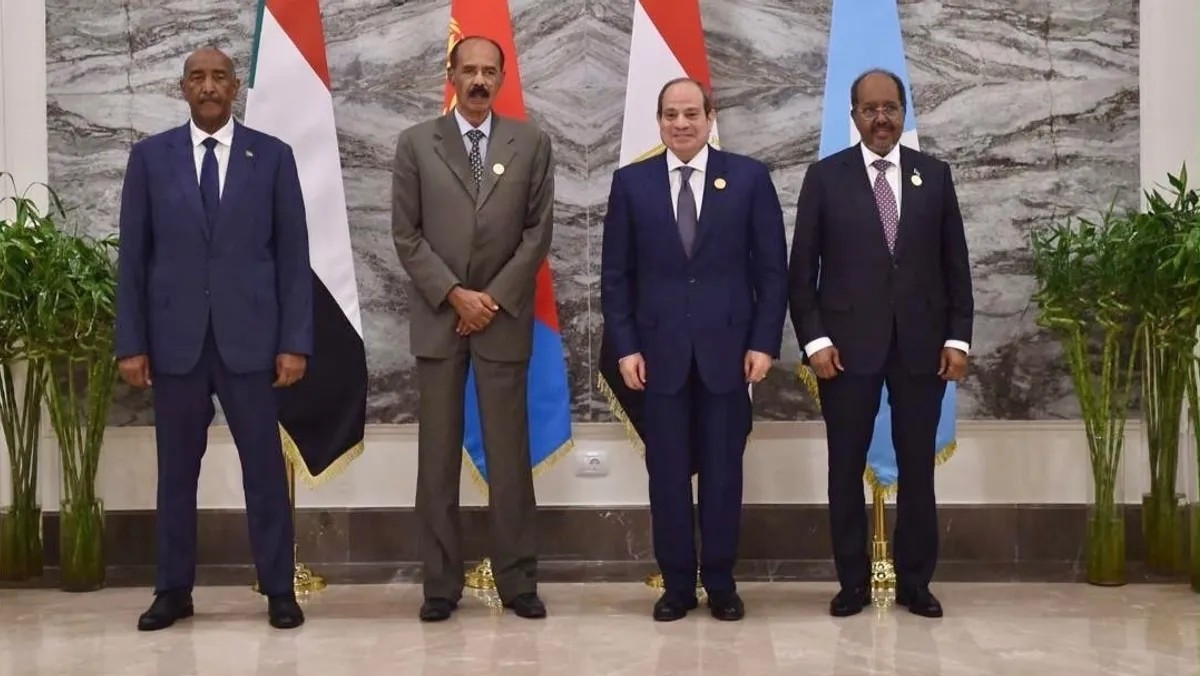
Egyptian President Abdel Fattah al-Sisi hosted Eritrean President Isaias Afwerki, Somali President Hassan Sheikh Mohamud and Sudanese army chief Abdel Fattah al-Burhan on Sunday in Egypt’s New Alamein city.
The meeting was the first four-way summit bringing together the leaders of the four countries. A joint statement following the meeting said that the four leaders discussed regional developments and agreed to strengthen political, trade and economic cooperation.
The leaders backed Sudan’s government and army, saying they supported the unity, sovereignty, territorial integrity and national institutions of the Republic of Sudan. They rejected the establishment of any parallel entities.
Sudan’s army, led by Burhan, continues to fight the paramilitary Rapid Support Forces in a war that began in April 2023. The two sides have accused neighboring countries of supporting opposing factions in the conflict.
The four countries agreed to reject unilateral measures that harm existing uses of Nile waters and reaffirmed their commitment to international law and prior consultation over transboundary rivers.
The leaders also discussed the situation in Somalia, reaffirming their support for Somalia's unity and independence and rejecting any interference aimed at undermining the country's sovereignty.
They specifically rejected recognition of Somaliland, which declared independence from Somalia in 1991 but has not secured broad international recognition.
The summit reflects growing efforts by Egypt, Somalia, Eritrea and Sudan to coordinate their positions on regional security, sovereignty and political stability.
Key facts
- The four countries held a summit in New Alamein city, Egypt, on October 4, 2026.
- The leaders discussed regional developments and agreed to strengthen political, trade and economic cooperation.
- They backed Sudan’s government and army, and rejected the establishment of any parallel entities.
- The four countries agreed to reject unilateral measures that harm existing uses of Nile waters.
Three perspectives
Neutral
The summit aimed to address regional tensions and promote cooperation among the four countries. The situation in Ethiopia and Sudan remains volatile, and the international community is awaiting further developments. The four countries' commitment to international law and prior consultation over transboundary rivers is a positive step.
Positive
The summit marked a significant step towards regional cooperation and stability. The leaders' commitment to supporting national institutions and promoting political and peaceful solutions to regional conflicts is a constructive approach. The rejection of unilateral measures that harm existing uses of Nile waters is also a positive development.
Negative
The ongoing conflicts in Ethiopia and Sudan pose a significant challenge to regional stability. The four countries' rejection of recognition of Somaliland may exacerbate tensions in the region. The summit's outcome may not be enough to address the deep-seated issues in the region, and further efforts are needed to achieve lasting peace and stability.
Your week in news, every Wednesday
The biggest stories of the week for your edition, in your inbox every Wednesday morning, your time. Free, and you can unsubscribe at any time.