

Cuba's U.N. resolution against U.S. embargo passes with declining support
The annual resolution passed 130-17, but Cuba lost significant support from countries in the Western Hemisphere and Europe.
 Politics Desk 3 min read
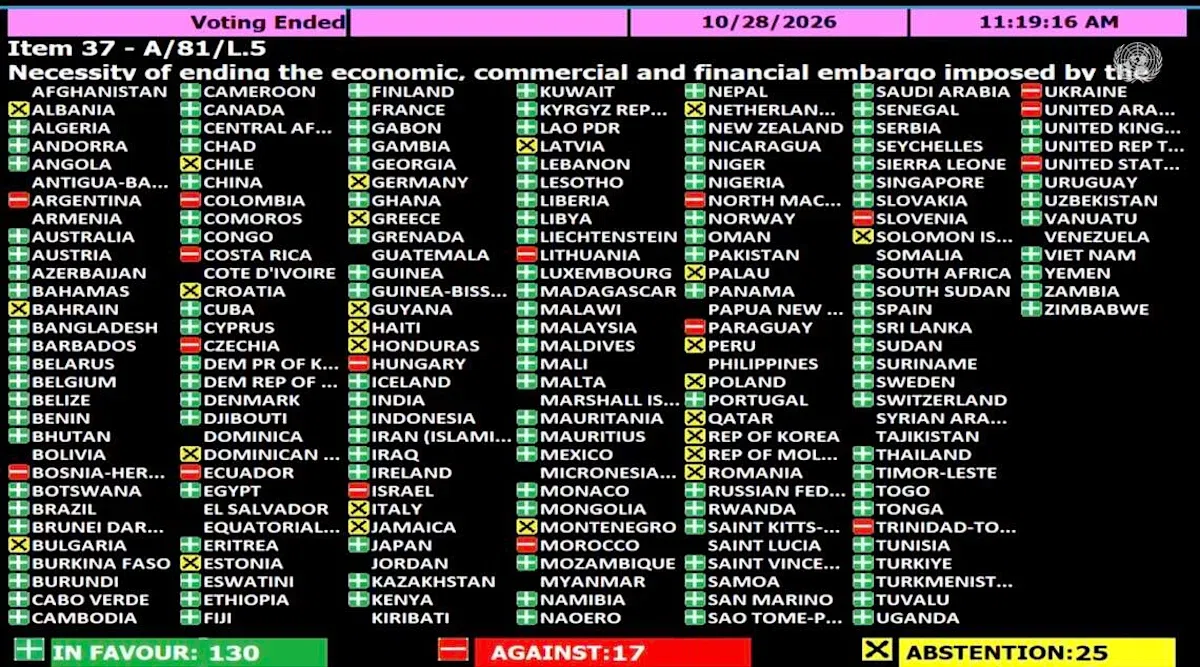
Cuba’s annual U.N. resolution against the U.S. embargo passed on Wednesday, but support from Western and European countries declined sharply. The resolution passed 130-17, with 25 abstentions, a sharp drop from last year when it won 165 votes, with seven against and 12 abstentions.
Ten countries joined the United States, Israel, Argentina, Paraguay, Hungary, North Macedonia and Ukraine in voting no this year. Colombia, Slovenia, Trinidad and Tobago and the United Arab Emirates switched from yes to no, while Bosnia and Herzegovina, Costa Rica, Ecuador, Lithuania and Morocco went from abstaining to voting against. Five Latin American countries voted against the resolution: Argentina, Paraguay, Colombia, Costa Rica and Ecuador.
In the Caribbean, Trinidad and Tobago voted no, and Jamaica, Guyana and Haiti abstained after voting yes last year. Antigua and Barbuda, Dominica and Saint Lucia, which also voted yes in 2025, did not vote. Mexico, Brazil, Uruguay and Panama were among the region's countries voting in favor.
The U.S. ambassador to the U.N., Mike Waltz, told members of the General Assembly that their vote was the only thing standing between the corrupt, kleptocratic, communist regime and using this body and your vote for another propaganda victory at the expense of the Cuban people. Cuban leader Miguel Díaz-Canel said on X that the victory was for the heroic Cuban people, who do not give in to the economic strangulation, threats, and abuse from the U.S. government.
Havana says the embargo cost Cuba $8.08 billion between March 1, 2025, and Feb. 28, 2026, the highest figure on record, though these estimates have not been independently confirmed. Cuban Foreign Minister Bruno Rodríguez denounced the situation as a fuel blockade equivalent to a naval blockade and an act of war. He also blamed the embargo for medicine shortages, rising cancer deaths and a water crisis on the island.
Only the U.S. Congress can lift the embargo. Ireland, speaking on behalf of the European Union, said that lifting the embargo could make economic reforms more effective, but placed much of the blame for the island's crisis on Havana. The representative said decisions made by the Cuban authorities, including structural weaknesses and lack of reforms, have significantly contributed to the current crisis.
Key facts
- The resolution passed with 130 votes in favor, 17 against, and 25 abstentions.
- Trinidad and Tobago voted no, while Jamaica, Guyana, and Haiti abstained.
- Havana estimates the embargo cost Cuba $8.08 billion between March 1, 2025, and Feb. 28, 2026.
Three perspectives
Neutral
The United Nations passed an annual resolution condemning the U.S. embargo on Cuba with 130 votes in favor and 17 against.
Positive
Cuban leader Miguel Díaz-Canel hailed the result as a victory for the heroic Cuban people.
Negative
Support for the resolution declined sharply from last year, with several Caribbean and Latin American nations voting against or abstaining.
Your week in news, every Wednesday
The biggest stories of the week for your edition, in your inbox every Wednesday morning, your time. Free, and you can unsubscribe at any time.