

Protein fibers in semen help deliver RNA to embryos
Researchers found that amyloid-like fibers formed from prostate enzymes can carry RNA into sperm cells and deliver it to embryos after fertilization.
 Science Desk 2 min read
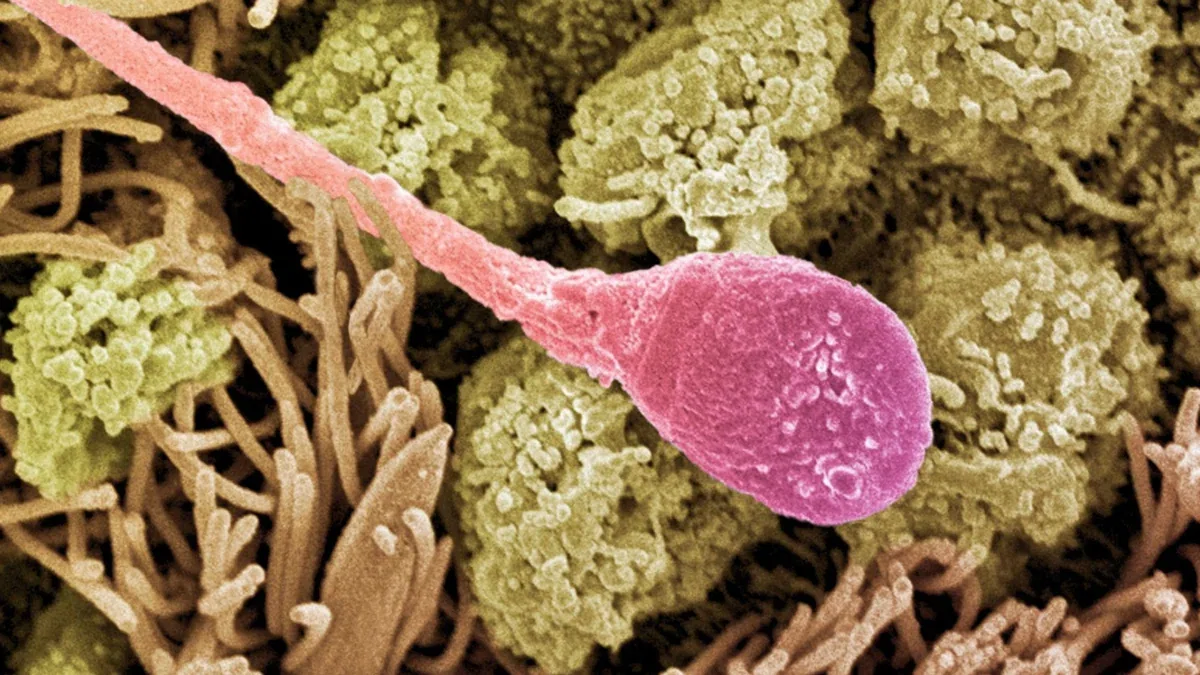
Tiny protein fibers in semen can help RNA in the surrounding fluid enter sperm cells. These fibers, which have an amyloid structure, can bind RNA, enter sperm, and help deliver that cargo to mouse embryos after fertilization.
The fibers are built from a fragment of prostatic acid phosphatase (PAP), an enzyme produced by the prostate. This fragment carries a positive electrical charge, while RNA carries a negative charge. In laboratory settings, the fragments and RNA bound together to form tiny droplets that developed into fibers containing RNA. The RNA actually helps assemble its own carrier.
Using cryo-electron tomography on bull sperm, researchers observed labeled fibers inside the cells. Structural biologist Anthony Fitzpatrick and physiologist William Mallen at Columbia University's Zuckerman Institute led the investigation. Fitzpatrick noted that sperm take the fibrils up whole and move them deep inside the cell, through the midpiece and up into the head.
In mouse fertilization experiments, sperm exposed to human PAP-made fibers delivered more RNA to the resulting two-cell embryos. One test used RNA that carries instructions for a green-light emitting protein, showing that embryos with the fibers contained at least ten times as much of the protein as those without fibers.
Understanding this route could help researchers design new tools for delivering RNA. Mallen explained that learning how disorders based on epigenetics work could help researchers treat or prevent metabolic disorders, such as insulin resistance, that may be passed down the paternal line.
It remains unclear what happens to the fibers once they reach an embryo, such as whether they are cleared or left in place. The team has not yet shown if naturally occurring fibers and their usual RNA cargo change anything in an embryo.
Key facts
- Protein fibers in semen can bind RNA and deliver it into sperm and subsequently into embryos.
- The fibers are formed from a fragment of the prostate enzyme prostatic acid phosphatase.
Three perspectives
Neutral
Researchers have identified a route by which RNA travels from seminal fluid into sperm and then into an embryo via amyloid-like protein fibers.
Positive
This discovery could help researchers design new tools for RNA delivery and potentially treat epigenetic metabolic disorders.
Negative
It is not yet known what becomes of the fibers once they reach an embryo or if naturally occurring fibers affect embryonic development.
Your week in news, every Wednesday
The biggest stories of the week for your edition, in your inbox every Wednesday morning, your time. Free, and you can unsubscribe at any time.