

NASA telescopes capture Cat's Head Nebula in Carina Nebula
The James Webb and Hubble Space Telescopes have captured a star-forming scene resembling a cat sitting with its back to the viewer.
 Space Desk 2 min read
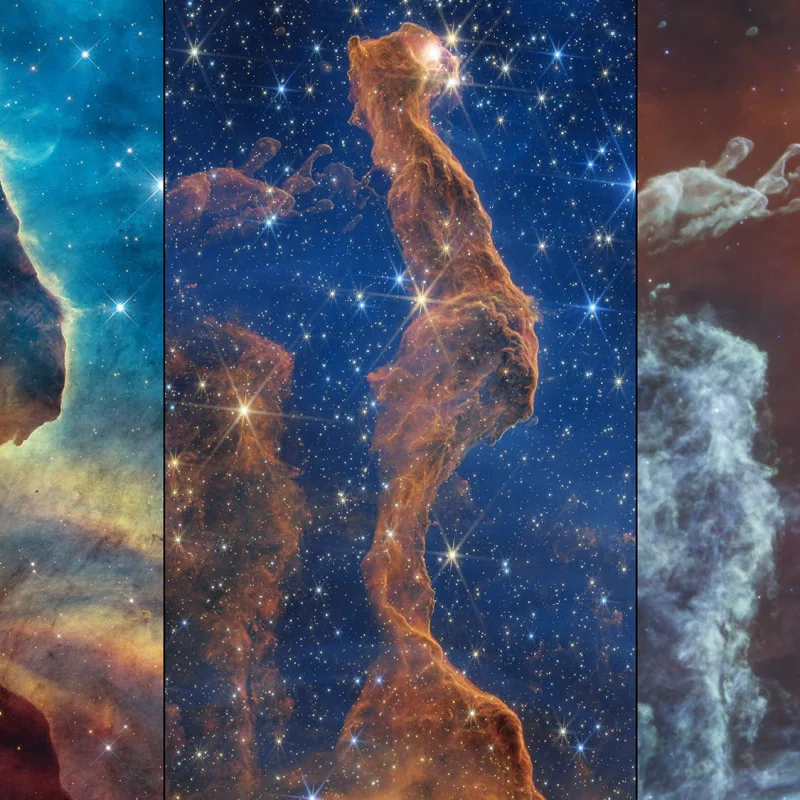
NASA's Hubble and James Webb Space Telescopes have captured a dynamic star-forming scene known as the Cat's Head Nebula. The nebula is located 7,500 light-years from Earth within the Carina Nebula.
The nebula resembles a cat sitting with its back to the viewer and its head turned to the right, including a glowing eye. This shape was likely formed by intense ultraviolet radiation and winds from massive stars in the Carina Nebula. Denser material within the feline-shaped pillar resists erosion from stellar feedback for now.
Hubble's visible-light view shows the opaque cosmic dust that forms the body of the cat. The James Webb Space Telescope uses mid-infrared and near-infrared wavelengths to peer through interstellar dust. Webb's Mid-InfraRed Instrument (MIRI) provides a rendition of the scene.
The Cat's Head Nebula is fertile ground for studying star formation. It will eventually disperse as growing stars change the complexion of the region.
The Carina Nebula is a large diffuse nebula containing newborn stars in gas and dust. It continues to produce bright and massive new stars. One object in the nebula, Eta Carinae, is a binary star that is likely to explode as a supernova.
Key facts
- The Cat's Head Nebula is located 7,500 light-years from Earth in the Carina Nebula.
- The nebula's shape was likely formed by ultraviolet radiation and winds from massive stars.
- Hubble captures visible-light views of cosmic dust, while Webb peers through dust using infrared wavelengths.
Three perspectives
Neutral
NASA's Hubble and James Webb Space Telescopes have captured images of the Cat's Head Nebula in the Carina Nebula.
Positive
The telescopes provide fertile ground for studying star formation and the makeup of the cloud.
Negative
The Cat's Head Nebula will eventually disperse as growing stars change the region's complexion.
Your week in news, every Wednesday
The biggest stories of the week for your edition, in your inbox every Wednesday morning, your time. Free, and you can unsubscribe at any time.