

Longest feather found in amber provides clues to dinosaur evolution
The discovery of a feather preserved in three dimensions suggests feathers developed size and shape before the strength needed for flight.
 Science Desk 2 min read
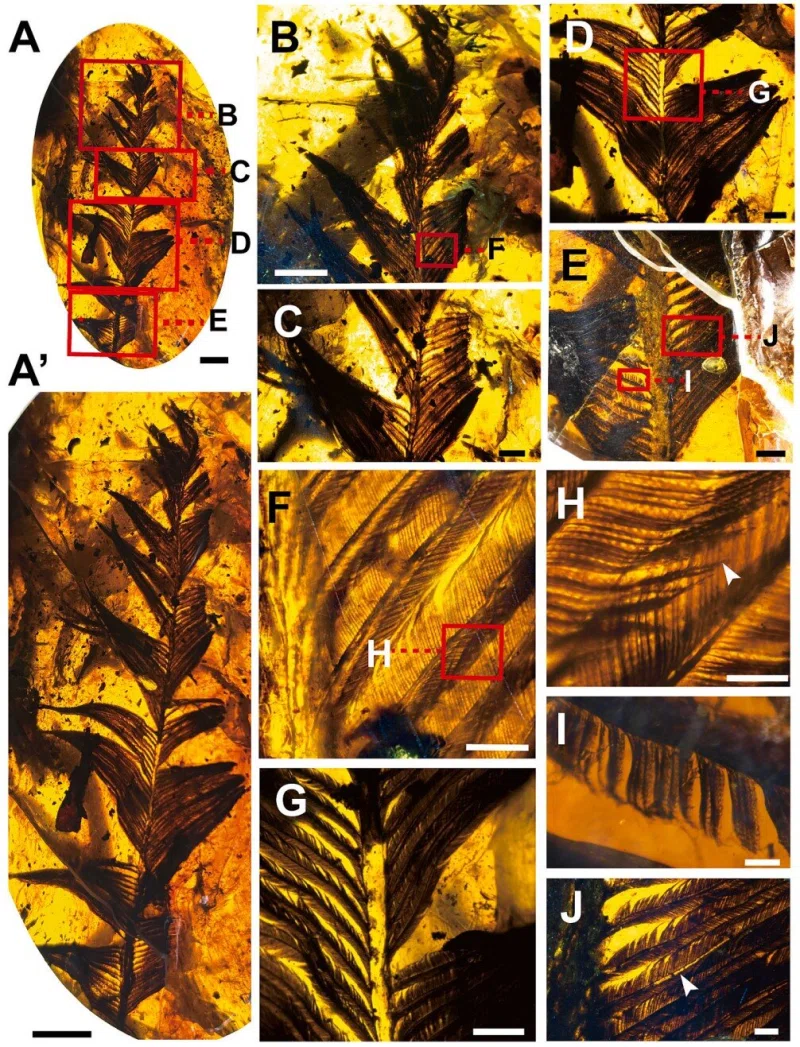
The longest feather ever found preserved in amber has been discovered, providing new clues about how dinosaur feathers evolved into structures used for flight. The feather belonged to an ancient dinosaur or early bird and became trapped in tree resin around 99 million years ago in what is now Myanmar.
Scientists led by Shuo Wang at East China Normal University in Shanghai examined the feather under a light microscope without removing it from the amber. They also extracted two small samples for closer inspection under a scanning electron microscope. Because the feather is preserved in three dimensions, researchers could examine intricate structural details that are often lost when fossil feathers flatten during fossilization.
Computer models comparing the ancient feather to a modern-style design revealed that the ancient specimen was structurally weaker. While the feather looked surprisingly modern in shape, its central shaft was unusually thin and lacked the internal structures that give modern feathers strength. It also lacked the tiny hooks that hold individual strands together to withstand the forces of flight.
Simulations showed that under identical airflow conditions, a feather with a shaft modeled on the ancient specimen bent around 10 times more than one with a modern-style shaft. These findings suggest that feathers developed their size and elaborate shape before acquiring the strength and structural features needed for effective flight. The morphology shows that major components of pennaceous feather construction did not arise simultaneously.
Key facts
- The feather was preserved in tree resin around 99 million years ago in Myanmar.
- The ancient feather's shaft bent around 10 times more than a modern-style shaft under identical airflow.
- Findings suggest feathers developed size and shape before acquiring the strength needed for effective flight.
Three perspectives
Neutral
The discovery of the longest known pennaceous feather embedded in amber provides new data on the evolutionary sequence of feather structures.
Positive
The three-dimensional preservation of the feather allowed scientists to examine intricate structural details.
Negative
The ancient feather lacked the internal structures and tiny hooks needed to withstand the forces of flight.
Your week in news, every Wednesday
The biggest stories of the week for your edition, in your inbox every Wednesday morning, your time. Free, and you can unsubscribe at any time.