

Cornell researchers develop laser-cooling technique for quantum computers
A new microfabricated chip technique can cool multiple types of atomic motion simultaneously to reduce a major bottleneck in quantum computing.
 Technology Desk 2 min read
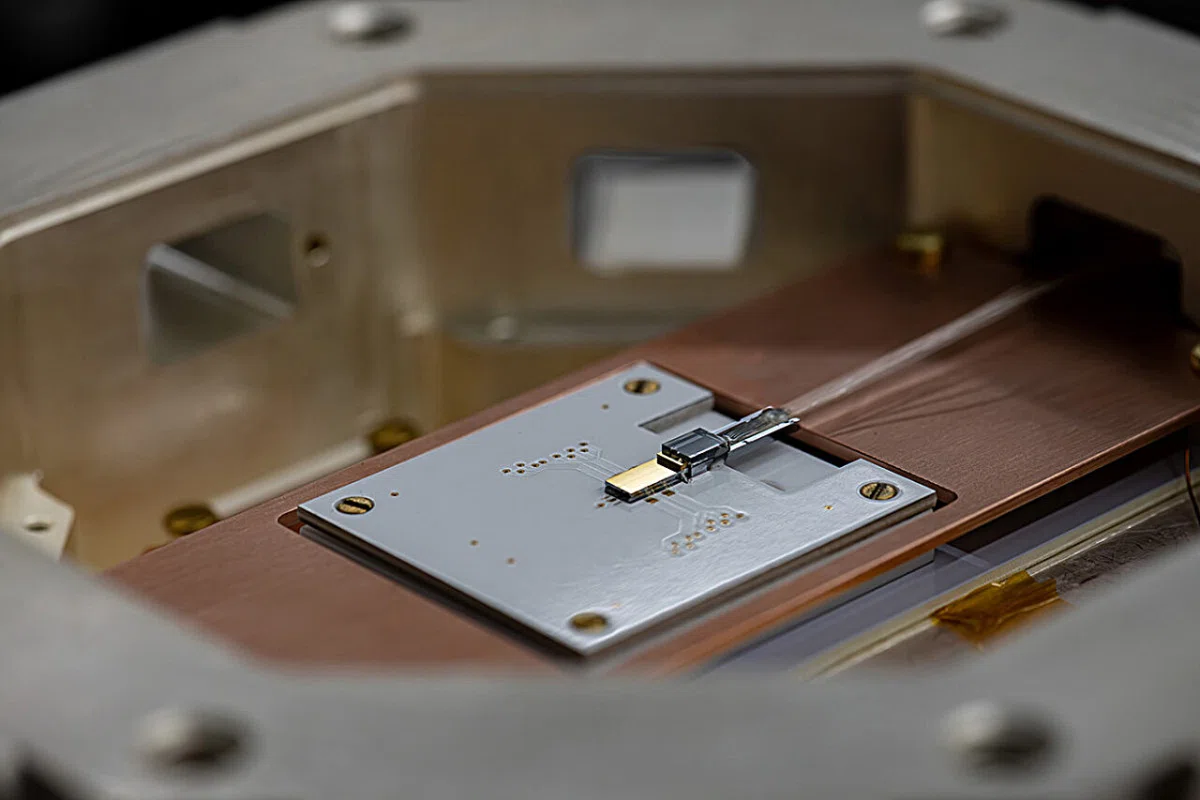
Researchers at Cornell have developed a laser-cooling technique that could remove a significant bottleneck in the development of larger, faster quantum computers. The findings, published Nov. 9 in the journal PRX Quantum, demonstrate how specially designed laser beams delivered through a microfabricated chip can cool multiple types of atomic motion simultaneously.
Trapped-ion quantum computers use individual electrically charged atoms suspended in electromagnetic fields to process information. While these ions offer precise quantum control, even tiny amounts of unwanted movement can interfere with calculations. Lasers must repeatedly cool the ions to near their lowest possible energy states, a process that can consume a large share of a quantum computer's operating time.
The research team, led by Karan Mehta, used an integrated photonic approach to guide light through microscopic pathways on the same chip that hosts the individual atoms. By using two laser beams traveling in opposite directions to create a standing wave, they positioned a trapped calcium ion at a point of minimum intensity to remove energy from its motion.
Using electromagnetically induced transparency cooling, the researchers brought the ion's targeted motion close to its quantum ground state in approximately 150 microseconds, compared with about 500 microseconds using a conventional laser arrangement. The technique also simultaneously cooled all three measured modes of the ion's motion across a frequency range of approximately 5 megahertz.
The optical components are integrated into a chip rather than relying on external lasers, an approach intended to extend systems to more qubits. Although the experiments involved a single ion, the approach is applicable to larger trapped-ion quantum computers.
The research was implemented by co-first authors Zhenzhong Xing and Hamim Mahmud Rivy, building on theoretical predictions by Xing. The chips were fabricated commercially in the Netherlands through a collaboration with ETH Zurich.
Key facts
- The new cooling technique reached the quantum ground state in 150 microseconds, faster than the 500 microseconds required by conventional arrangements.
- The technique simultaneously cooled all three measured modes of the ion's motion.
- The research was led by Karan Mehta at the Cornell Duffield College of Engineering.
Three perspectives
Neutral
Researchers have demonstrated a method to cool trapped ions using integrated photonic components on a microfabricated chip.
Positive
The technique could remove a significant bottleneck in the development of larger, faster quantum computers by cooling multiple types of atomic motion simultaneously.
Negative
Cooling operations to near the quantum ground state can be a major bottleneck in leading quantum computing systems.
Your week in news, every Wednesday
The biggest stories of the week for your edition, in your inbox every Wednesday morning, your time. Free, and you can unsubscribe at any time.