

Model shows road improvements can expand cancer care access in Rwanda
Research suggests paving roads can complement building new facilities to help patients reach oncology services.
 Health Desk 2 min read
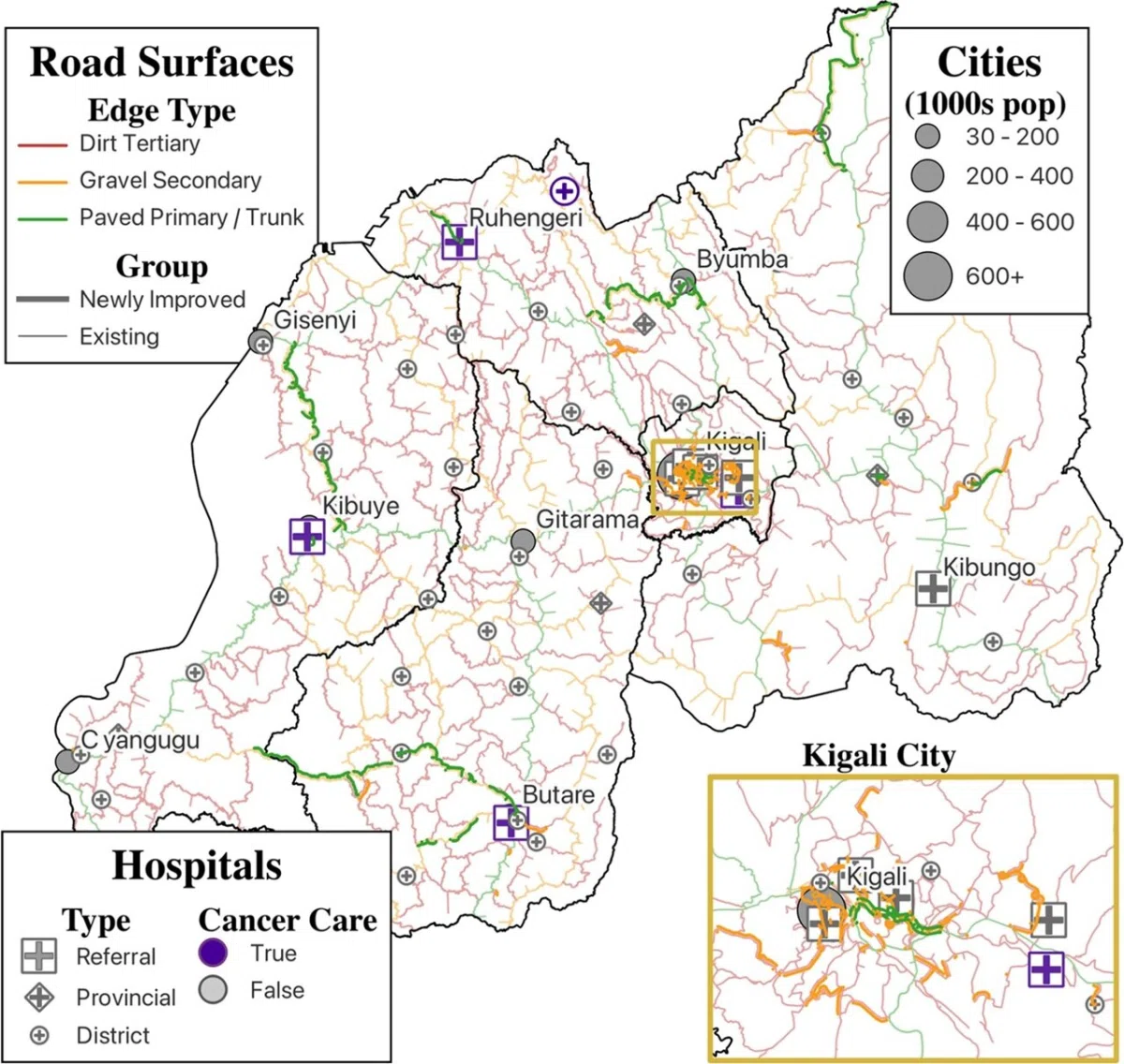
A mathematical model suggests that improving roads can complement investments in new cancer treatment facilities to expand access, even in areas where building new facilities may not be viable. The model was developed by Abel Sapirstein, a Ph.D. student at Georgia Tech, alongside faculty members Lauren Steimle and Mathieu Dahan.
The research evaluated trade-offs between using a fixed budget to build more cancer hospitals or to pave roads, while also accounting for a fixed number of oncologists.
The model used roughly 7,500 road segments, 1,066 population centers, and 48 potential facility locations to simulate Rwanda's cancer care network. In one scenario with four oncologic teams, average travel time during the rainy season fell from six hours to three hours.
In Rwanda, 70% of people travel more than two hours for care even during dry seasons. Currently, only 35% of estimated cancer cases are diagnosed, and 75% of those diagnosed are caught at severe stages, which contributes to an estimated 10% of premature deaths.
Sapirstein, who spent four months in Rwanda learning about the health system, noted that geographic access is a fundamental dimension of care. He stated that if care is not geographically accessible, other dimensions such as affordability or patient desire for treatment become moot.
Key facts
- Improving roads can expand cancer care access in areas where building new facilities is not viable.
- In a model scenario with four oncologic teams, rainy season travel times fell from six hours to three hours.
- 75% of diagnosed cancer cases in Rwanda are caught at severe stages.
Three perspectives
Neutral
A mathematical model was developed to help health systems decide how to invest limited resources in cancer facilities and roads in Rwanda.
Positive
The model showed that road improvements can meaningfully improve access in areas where additional cancer facilities could not be built.
Negative
Heavy rains often wash out roads in Rwanda, making the journey to care unpredictable or impossible.
Your week in news, every Wednesday
The biggest stories of the week for your edition, in your inbox every Wednesday morning, your time. Free, and you can unsubscribe at any time.