

Astronomers have found a vast reservoir of hydrogen with missing starlight
The object AGC 322753 contains roughly 2 billion times the sun's mass in neutral hydrogen and is a promising dark galaxy candidate.
 Space Desk 2 min read
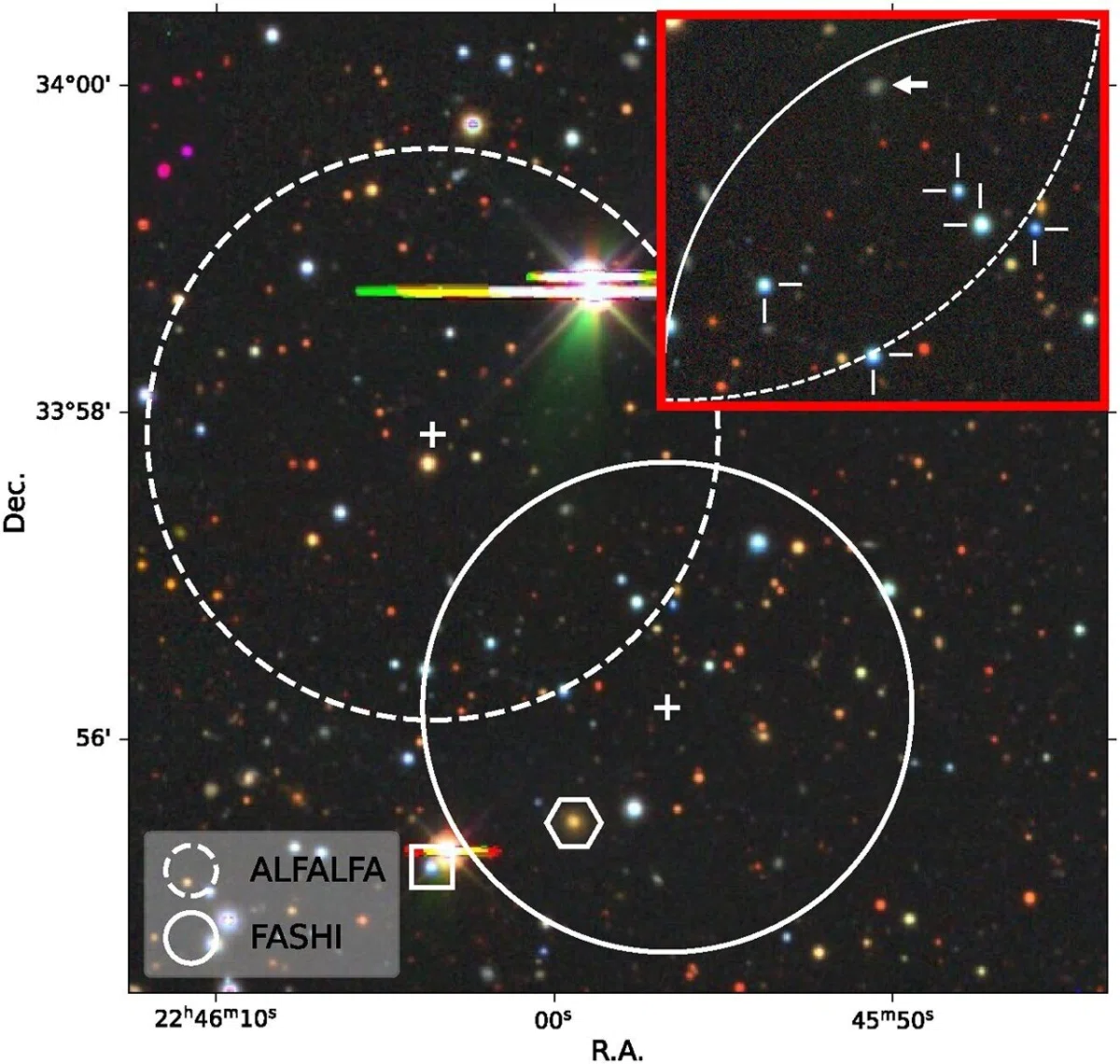
Astronomers have found a vast reservoir of hydrogen with something conspicuously missing: detectable starlight. The object, called AGC 322753, contains roughly 2 billion times the sun's mass in neutral hydrogen. Located about 310 million light-years away, it is a promising dark galaxy candidate with very few stars, or perhaps none.
Marco Monaci and colleagues at Swinburne University of Technology in Australia describe the object in Monthly Notices of the Royal Astronomical Society. The team compared dark-galaxy candidates from the ALFALFA survey, conducted with the decommissioned Arecibo radio telescope, against detections from a survey using China's FAST telescope. Both surveys pick up radio emission from neutral hydrogen, allowing astronomers to find gas even where stars are too faint to see.
The researchers found 13 matching sources between the catalogs and singled out AGC 322753 after checking nearby galaxies, image quality, and possible visible counterparts. Its two radio detections agreed closely in velocity and signal shape. Separate telescopes observing it at different times provided evidence that the signal came from space rather than radio interference. Both observations contained two peaks, a pattern consistent with gas rotating in a disk.
Experiments adding artificial galaxies to images suggested a rough upper limit of 50 million solar masses in stars. Under those assumptions, AGC 322753 contains at least 40 times more neutral hydrogen than stars. The object could have a stellar mass too low to be detectable in the Legacy Surveys.
An alternative explanation is that the gas could have been pulled from neighboring galaxies by gravitational interactions. The nearest known luminous neighbor is about 950,000 light-years away in projected separation. While the distance, large gas mass, and apparent rotation argue against such an origin, researchers cannot rule it out.
Sharper radio observations could establish whether the gas really forms a rotating disk. Deeper optical images could reveal hidden stars. Finding them would still leave an intriguing galaxy to explain: one holding an enormous supply of gas with remarkably little starlight.
Key facts
- AGC 322753 contains roughly 2 billion times the sun's mass in neutral hydrogen.
- The object is located about 310 million light-years away.
- The object contains at least 40 times more neutral hydrogen than stars under certain assumptions.
Three perspectives
Neutral
Astronomers have identified AGC 322753, a vast reservoir of hydrogen that lacks detectable starlight.
Positive
Sharper radio observations and deeper optical images could reveal whether the gas forms a rotating disk or contains hidden stars.
Negative
It is not yet confirmed if the gas is a rotating disk or if it was pulled from neighboring galaxies by gravitational interactions.
Your week in news, every Wednesday
The biggest stories of the week for your edition, in your inbox every Wednesday morning, your time. Free, and you can unsubscribe at any time.