

Researchers measure shortest high-energy X-ray pulses ever recorded
The attosecond pulses at the SLAC National Accelerator Laboratory allow scientists to record electronic motion frozen in time.
 Science Desk 2 min read
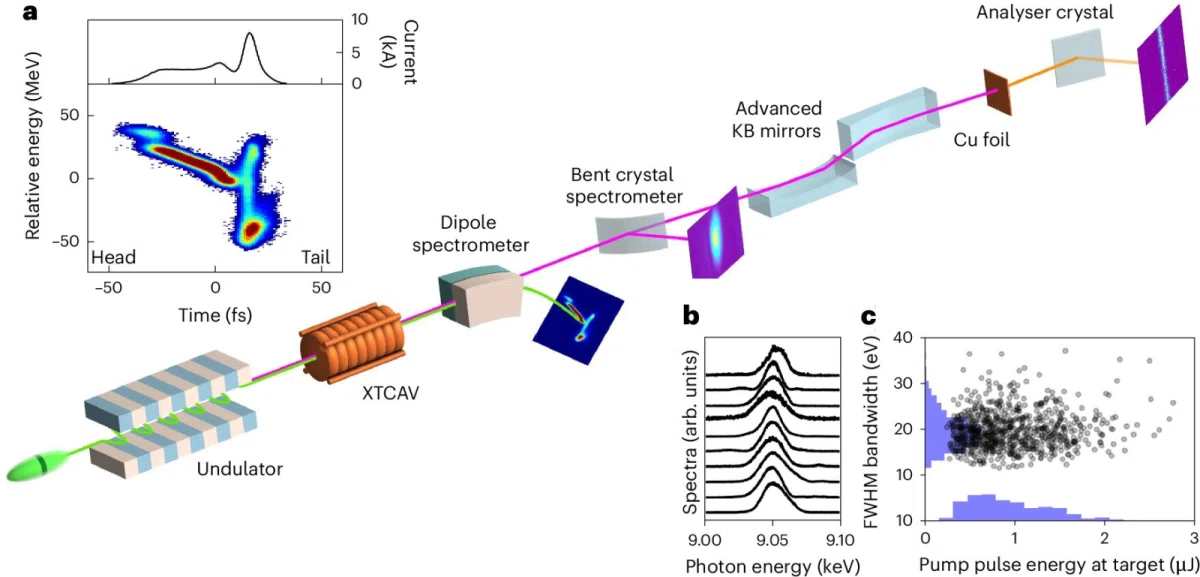
Researchers at the Linac Coherent Light Source (LCLS) at the U.S. Department of Energy's SLAC National Accelerator Laboratory have measured the shortest high-energy X-ray pulses ever recorded at an X-ray free-electron laser (XFEL). The pulses had photon energies of about 9 kiloelectronvolts (keV) and clocked in at durations of 100 to 400 attoseconds. An attosecond is one billionth of a billionth of a second.
The study's lead author, Ichiro Inoue, a professor at the University of Tokyo, proposed using amplified spontaneous emission (ASE) to indirectly measure the duration of the LCLS pulses. ASE occurs when intensely focused X-ray pulses excite a specific element, causing it to fluoresce in a forward direction. This fluorescence contains information about the original X-ray pulse's energy, shape, and duration. By combining energy and spectrum measurements, the team calculated the pulse duration.
Agostino Marinelli, a study author and professor at SLAC, said the pulses are energetic enough to look deep into atomic systems and fast enough to record electronic motion frozen in time. Marinelli explained that the challenge was not creating the pulses, but proving they had been done. This was the first diagnostic that proves the pulses are indeed only a few hundred attoseconds long.
High-energy X-rays, or hard X-rays, penetrate deeper into materials than soft X-rays. They can be used to capture images with enough resolution to pinpoint the location of electrons with atomic-scale accuracy. These pulses also allow researchers to outrun X-ray-induced damage to electronic states of matter.
The results are published in Nature Photonics.
The demonstration opens attosecond science to new users, including researchers studying plasmas found in stars and inertial fusion energy experiments. Tais Gorkhover, head of the advanced ultrafast X-ray imaging group at the University of Hamburg, plans to use these pulses to sharpen nanoscale images made by absorption and scattering.
Key facts
- The measured X-ray pulses lasted between 100 and 400 attoseconds.
- The pulses had photon energies of approximately 9 kiloelectronvolts.
- The research was conducted at the SLAC National Accelerator Laboratory.
Three perspectives
Neutral
Researchers at the SLAC National Accelerator Laboratory have measured high-energy X-ray pulses lasting 100 to 400 attoseconds.
Positive
These pulses allow scientists to capture electronic states in a pristine state by outrunning X-ray-induced damage.
Negative
Measuring pulses this short is extremely difficult.
Your week in news, every Wednesday
The biggest stories of the week for your edition, in your inbox every Wednesday morning, your time. Free, and you can unsubscribe at any time.