

LHCb finds evidence of rare beauty meson decay
The CERN collaboration identified a decay occurring once in every 10 billion particles, reaching a statistical significance of 3.2 sigma.
 Science Desk 2 min read
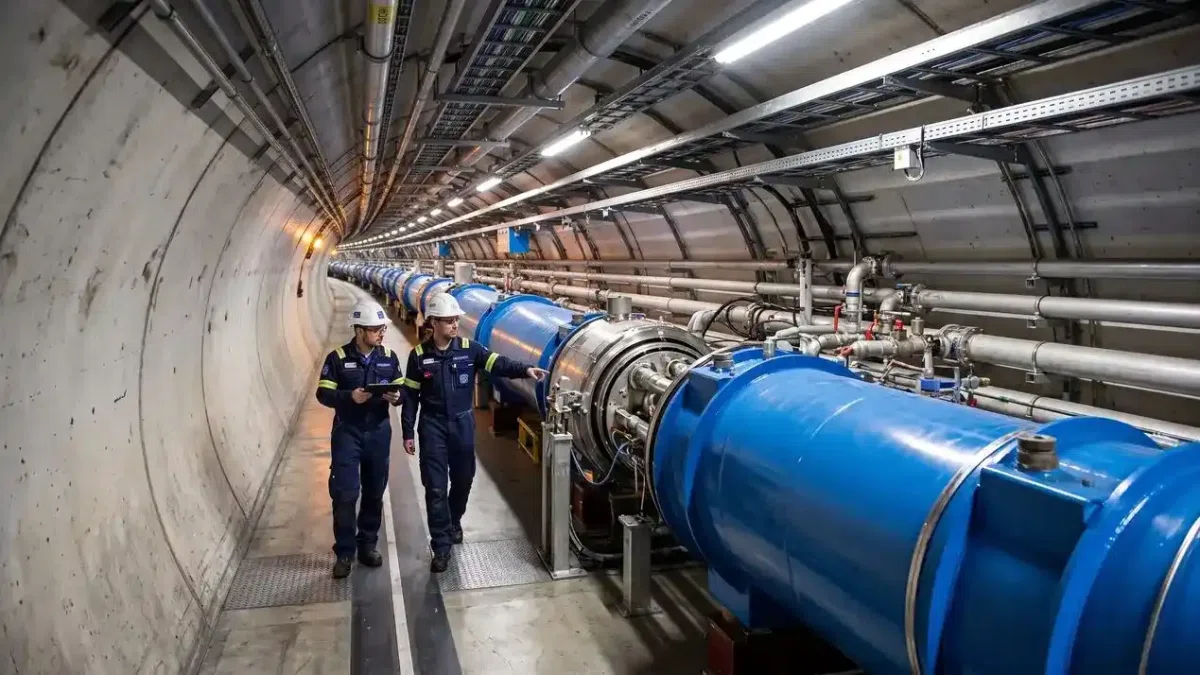
CERN’s LHCb collaboration has identified evidence of an extraordinarily rare transformation of a neutral beauty meson, known as Bd or B0, in its own collision data. The decay into two muons is a process physicists expect to occur only about once in every 10 billion decays of the particle.
The result reaches a statistical strength of 3.2 sigma, which is above the threshold for evidence but below the five sigma benchmark required for a discovery. The measurements agree with the Standard Model rather than revealing an unexpected particle.
The achievement relied on an upgraded detector, including a silicon pixel Vertex Locator (VELO) assembled by a team from the University of Liverpool. This upgrade allows the LHCb to collect data at up to five times its earlier rate. The analysis used proton collisions recorded in 2024 and 2025.
The VELO sits five millimeters from the LHC beams and helps track particles emerging from collisions to identify where short-lived particles decay. Researchers used improved particle identification and machine-learning techniques to suppress background signals that resemble the desired outcome.
LHCb studies particles containing beauty quarks, which are heavier relatives of the up and down quarks found in ordinary matter. These particles form during high-energy collisions inside the Large Hadron Collider and survive only briefly before transforming into other particles.
The collaboration described the analysis in a preprint submitted to Physical Review X. The work involved contributions from the University of Manchester and nearly 90 UK companies.
Key facts
- The decay occurs roughly once per 10 billion beauty mesons.
- The statistical significance of the evidence is 3.2 sigma.
- The upgraded detector allows data collection at up to five times the previous rate.
Three perspectives
Neutral
The measured decay probability agrees with the Standard Model and does not reveal an unexpected particle.
Positive
The upgraded detector technology helped physicists identify the rare signal and allows for faster data collection.
Negative
The statistical strength of 3.2 sigma falls short of the five sigma threshold required to claim a discovery.
Your week in news, every Wednesday
The biggest stories of the week for your edition, in your inbox every Wednesday morning, your time. Free, and you can unsubscribe at any time.