

 United States
Webb telescope captures turbulent star-forming region N159
Astronomers used the James Webb Space Telescope to observe a cosmic cauldron of gas and dust 161,000 light-years away in the Large Magellanic Cloud.
 Space Desk 2 min read
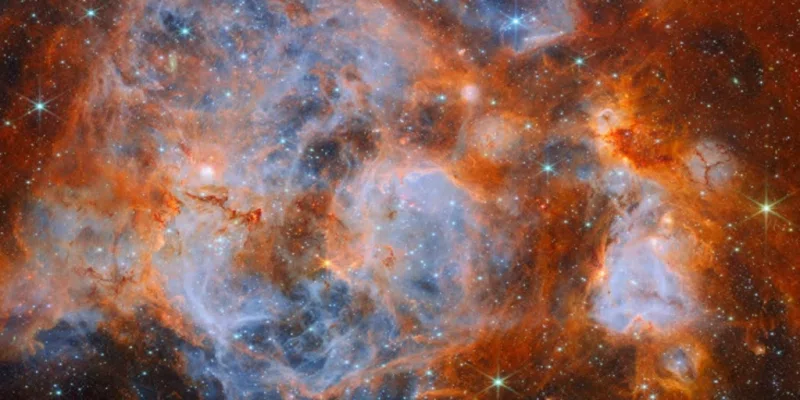
Astronomers using the NASA/ESA James Webb Space Telescope have captured a turbulent star-forming region known as N159. The region is located 161,000 light-years away in the Large Magellanic Cloud, which is a satellite galaxy orbiting the Milky Way.
The observation was selected as Webb’s Picture of the Month for October. NASA commented that the agency visited the turbulent cauldron of star formation to see what is brewing inside dense clumps of gas.
The colors in the image reveal the chemistry of the region. Light orange areas represent light emitted by polycyclic aromatic hydrocarbons, which are important carbon-based molecules. Pale blue gas clouds consist of ionized hydrogen, or H II gas, energized by intense ultraviolet light from massive stars.
Dark red filaments made of cool molecular hydrogen stretch across the center of the image. These filaments are the densest parts of the nebula and help shield new stars from stellar winds and harsh radiation.
According to NASA, the region has a lower metallicity than the Milky Way. This proportion of elements heavier than hydrogen and helium gives astronomers an opportunity to learn how stars formed under conditions in the early universe.
Key facts
- The N159 star-forming region is located 161,000 light-years away in the Large Magellanic Cloud.
- The region has a lower metallicity than the Milky Way.
- The image was selected as Webb’s Picture of the Month for October.
Three perspectives
Neutral
The James Webb Space Telescope captured an image of the N159 star-forming region in the Large Magellanic Cloud.
Positive
The image offers astronomers a closer look at the turbulent clouds of gas where new stars are born.
Negative
The region contains harsh radiation and stellar winds that new stars must be shielded from.
Your week in news, every Wednesday
The biggest stories of the week for your edition, in your inbox every Wednesday morning, your time. Free, and you can unsubscribe at any time.