Arctic winter sea ice likely to shrink by 1 million square kilometers more than expected
Researchers used 6,000-year-old algae biomarkers to improve climate model reliability and refine future ice loss projections.
 Climate Desk 2 min read
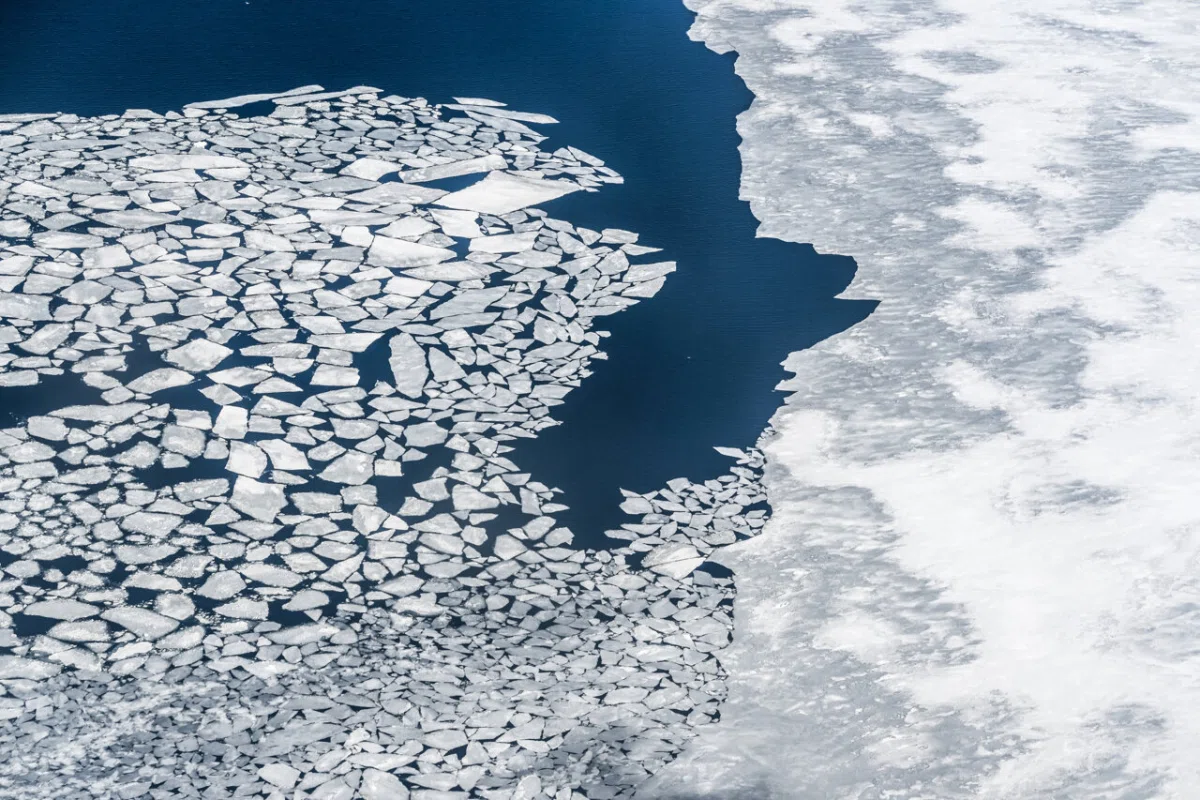
Future Arctic winter sea ice is likely to shrink by approximately 1 million square kilometers (386,000 square miles) more than previous estimates. Researchers from the University of Cambridge and the Centro de Investigación en Matematicas in Mexico (CIMAT) reached this conclusion by using clues from a warm period 6,000 years ago to improve the reliability of climate models.
The study, reported in Nature Geoscience, utilized the largest-ever database of IP₂₅, a biomarker produced by algae living in sea ice. By comparing these ancient measurements from ocean sediment cores to simulations from 27 climate models, the team used Bayesian weighting to prioritize models that accurately reproduced mid-Holocene sea ice conditions.
Lead author Crystal Fu from Cambridge's Scott Polar Research Institute said that applying these model weights to historical simulations eliminated positive bias. Fu noted that while the warming in the mid-Holocene was caused by orbital shifts rather than human activity, sea ice responds to warming in the same way regardless of the cause.
The revised projections suggest that the loss of winter sea ice could influence weather patterns in the U.K., northern Europe, and North America. Co-author Marco Aquino-López of CIMAT said the approach reduced the range of uncertainty in projections by as much as 85%, providing a clearer picture of where ice is likely to disappear.
The research also found hints that knock-on effects may be larger than expected. Applying the revised weights to precipitation projections suggests that snowfall over southeast Greenland and rainfall in the Mediterranean may be underestimated, which could impact the stability of the Greenland ice sheet and flood risks in southern Europe.
In the Southern Hemisphere, Antarctic sea ice reached its annual maximum extent on 14 September 2026. According to NASA and the National Snow and Ice Data Center (NSIDC), this extent of 17.59 million square kilometers was the third-lowest maximum in the satellite record.
Key facts
- Arctic winter sea ice projections have been revised downward by about 1 million square kilometers.
- Researchers used IP₂₅ biomarkers from mid-Holocene sediment cores to weight 27 climate models.
- The study reduced the uncertainty in winter sea ice projections by as much as 85%.
- Antarctic sea ice reached its 2026 annual maximum on 14 September, the third-lowest on record.
Three perspectives
Neutral
Scientists are using paleoclimate data to refine the accuracy of future Arctic sea ice projections.
Positive
The new methodology reduced the range of uncertainty in sea ice projections by as much as 85%.
Negative
Arctic winter sea ice is projected to shrink by 1 million square kilometers more than previously thought.
Your week in news, every Wednesday
The biggest stories of the week for your edition, in your inbox every Wednesday morning, your time. Free, and you can unsubscribe at any time.