

Interstellar comet 3I/ATLAS shows dusty ice signature
Astronomers using the James Webb Space Telescope found that the interstellar comet's ice contains more dust than typical comets in our solar system.
 Space Desk 2 min read
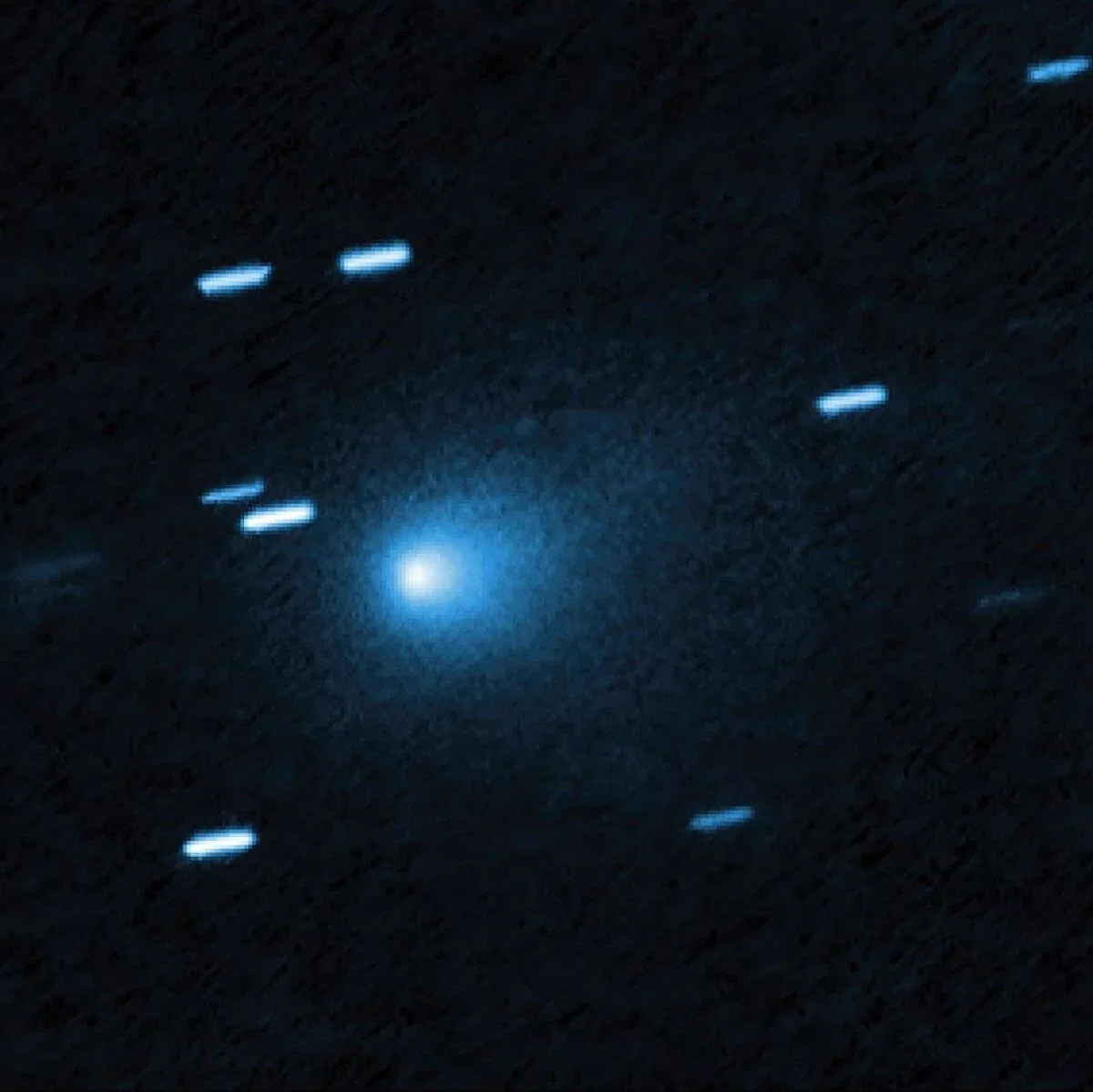
Astronomers have identified unusual ice properties in the interstellar comet 3I/ATLAS. A Southwest Research Institute team used NASA's James Webb Space Telescope to observe the comet three times between August 2025 and April 2026, both before and after its closest pass to the sun.
The telescope's ability to spread light into a rainbow allowed researchers to detect water ice through specific infrared patterns. While most comets around the sun show one deep mark and two faint marks in this pattern, 3I/ATLAS showed two faint marks that barely registered or were missing entirely.
Computer simulations suggest this occurs when tiny bits of ice are blended with more dust, which blocks light from penetrating deep into the ice. Silvia Protopapa, lead author of a paper in The Astrophysical Journal Letters, said that while 3I/ATLAS looks different from known icy comets, its makeup aligns with distant icy worlds in our own solar system located far past Neptune.
This finding suggests that the raw materials for building planets may be similar across different star systems, as ice may form in similar ways as grains ranging from nearly pure to heavily dusty. The comet's composition matches several Trans-Neptunian objects that also carry carbon dioxide ice and carbon-rich compounds.
By April, Webb's readings indicated a second crop of ice-rich grains that were slightly larger but still measured roughly a micron.
Key facts
- The interstellar comet 3I/ATLAS was observed by the James Webb Space Telescope between August 2025 and April 2026.
- Researchers found the comet's makeup is similar to icy bodies located beyond Neptune.
Three perspectives
Neutral
Astronomers used the James Webb Space Telescope to study the ice composition of the interstellar comet 3I/ATLAS.
Positive
The findings suggest that the raw materials used to build planets may look much alike from one star to the next.
Negative
Researchers are still unable to tell if changes in the comet's grains are due to solar heating or surface erosion.
Your week in news, every Wednesday
The biggest stories of the week for your edition, in your inbox every Wednesday morning, your time. Free, and you can unsubscribe at any time.