

Bacteria molecule discovered to heal intestinal lining and boost NAD
Scientists at Rutgers Health found that N-MNA, produced by good gut bacteria, can repair damaged guts and increase levels of a coenzyme that declines with age.
 Health Desk 2 min read
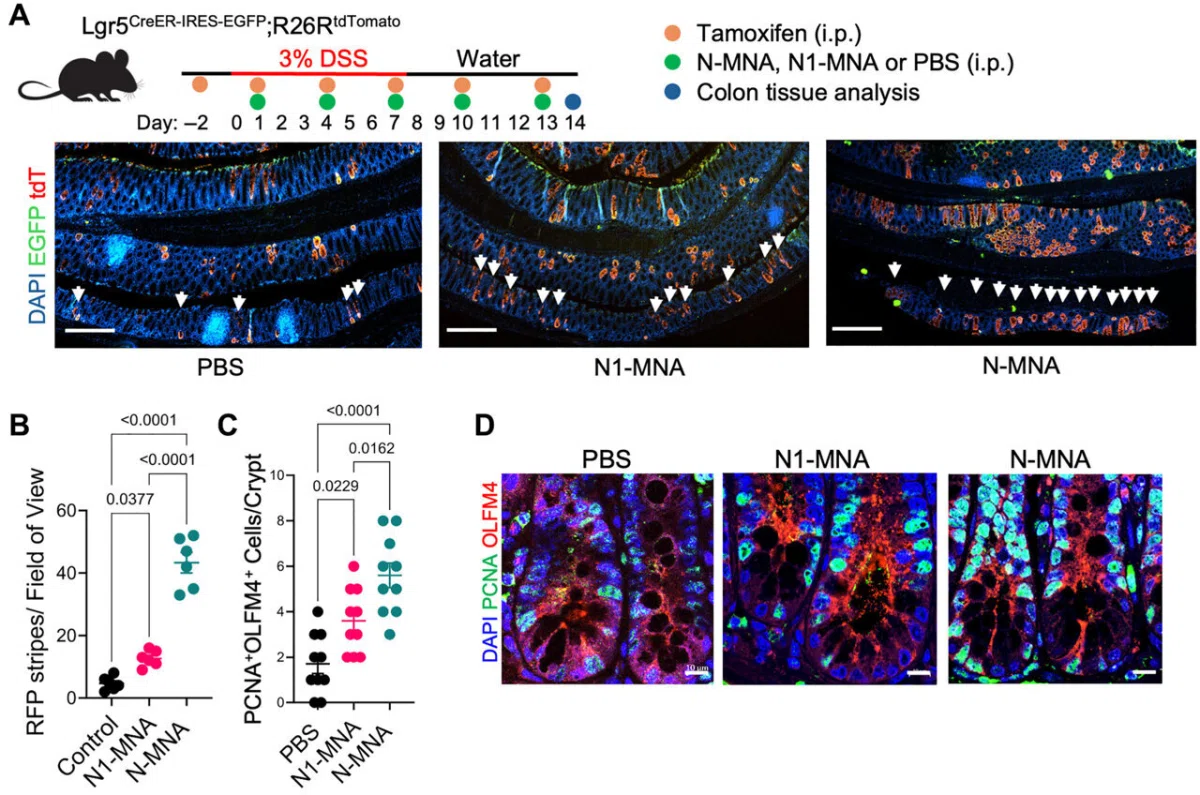
Scientists at Rutgers Health have discovered a molecule produced by good gut bacteria that rapidly heals the intestinal lining. The molecule, called (amide-)N-methylnicotinamide or N-MNA, protects against severe inflammatory diseases and triggers increased production of a coenzyme called nicotinamide adenine dinucleotide or NAD.
In tests involving mice, flies and human cells, researchers found N-MNA has the potential to treat inflammatory bowel disease and other chronic gut disorders. N-MNA is a precursor molecule that activates NAD, which speeds the repair of damaged guts by stimulating stem cell regeneration. Because NAD cannot enter cells directly, scientists have sought precursors that can be taken up by cells and converted into NAD.
In mice with inflamed and damaged colons, untreated animals lost 20% of their body weight and died, while those injected with N-MNA lost 5% and recovered. In fruit flies with damaged guts, N-MNA raised seven-day survival from 43% to 78%. Jiangmeng Han tracked the molecule into human colon cells, where it supplied about 22% of their NAD within 24 hours.
Senior study author Nan Gao, a professor at Rutgers New Jersey Medical School, said humans do not appear to make N-MNA, but some bacteria living in the gut do. Patients with inflammatory bowel disease and low levels of this metabolite showed higher inflammatory activity in stool samples. Gao said a stool test might eventually help identify patients likely to benefit from probiotics, though this is probably some years away.
Xiaoyang Su, an associate professor of medicine at Rutgers Robert Wood Johnson Medical School, said the molecules animal cells and bacteria make are almost identical, but a tiny difference allows the bacterial compound to be converted back into NAD. Rutgers has filed a provisional patent application on uses of N-MNA.
Researchers did not test N-MNA treatment in IBD patients, nor did they test if consuming probiotic strains that make N-MNA, such as Lactobacilli in yogurt, raises NAD in people. Ching-On Wong, an assistant professor of biological sciences at Rutgers-Newark, said the compound itself may be sufficient, but they cannot rule out the possibility of other, better compounds.
Key facts
- N-MNA is a molecule produced by good gut bacteria that can be converted into NAD.
- In mice with damaged colons, N-MNA injection resulted in a 5% weight loss and recovery, compared to 20% weight loss and death in untreated mice.
- N-MNA supplied approximately 22% of NAD in human colon cells within 24 hours.
Three perspectives
Neutral
Scientists have identified a bacterial molecule, N-MNA, that can be converted into the coenzyme NAD to assist in intestinal repair.
Positive
The discovery of N-MNA shows potential for treating inflammatory bowel disease and could eventually lead to stool tests to identify patients who benefit from probiotics.
Negative
Researchers have not yet tested N-MNA treatment in humans with inflammatory bowel disease or confirmed if probiotics containing N-MNA-producing bacteria raise NAD in people.
Your week in news, every Wednesday
The biggest stories of the week for your edition, in your inbox every Wednesday morning, your time. Free, and you can unsubscribe at any time.