

Interstellar comet 3I/ATLAS shows high heavy hydrogen levels
Methane in the interstellar comet 3I/ATLAS has a deuterium-to-hydrogen ratio about 13 times higher than comet 67P/Churyumov-Gerasimenko.
 Space Desk 2 min read
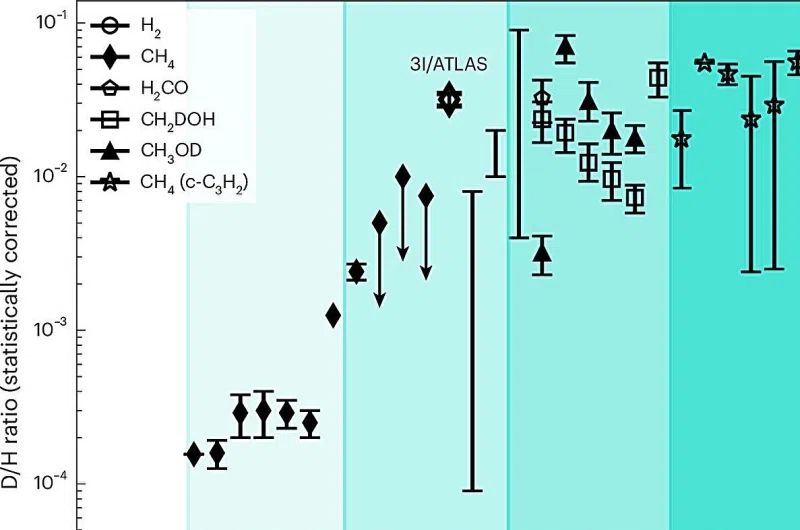
The interstellar comet 3I/ATLAS carries a chemical clue to the conditions in the planetary system where it originated. Using the James Webb Space Telescope, Nathan Roth of American University and NASA's Goddard Space Flight Center and colleagues measured a heavy-to-ordinary hydrogen ratio in 3I/ATLAS that is about 13 times as high as that of comet 67P/Churyumov-Gerasimenko.
The researchers measured a deuterium-to-hydrogen ratio of approximately 3.2% in the comet's methane. This ratio exceeds any other value for methane measured in the solar system. The Webb telescope observed 3I/ATLAS on Dec. 22 and 23, 2025, when it was about 2.4 times as far from the sun as Earth is.
Heavy hydrogen, called deuterium, has an extra neutron in its nucleus and can replace ordinary hydrogen in a methane molecule. In extremely cold gas, some chemical reactions favor the incorporation of deuterium into molecules. At temperatures around 10 degrees above absolute zero, reactions that would undo that enrichment become less effective.
The methane's D/H ratio was about three times the ratio previously measured in the water of 3I/ATLAS. Researchers suggest the methane may have formed later, after the surrounding chemistry had more time to concentrate heavy hydrogen. The findings fit with a theory that 3I/ATLAS originated in a cold cloud or an environment surrounding a forming star with a high rate of cosmic-ray bombardment.
The measurement provides a rare opportunity to investigate the early chemistry of another planetary system. However, direct measurements of methane's D/H ratio in distant star-forming environments are lacking. The comet gives existing chemical models a demanding test.
Key facts
- The methane in comet 3I/ATLAS has a deuterium-to-hydrogen ratio of approximately 3.2%.
- The D/H ratio in 3I/ATLAS is about 13 times higher than that of comet 67P/Churyumov-Gerasimenko.
- Webb observed the comet on Dec. 22 and 23, 2025.
Three perspectives
Neutral
The interstellar comet 3I/ATLAS contains methane with a deuterium-to-hydrogen ratio that exceeds any other value measured in the solar system.
Positive
The findings give scientists a rare opportunity to investigate the early chemistry of another planetary system.
Negative
Direct measurements of methane's D/H ratio in distant star-forming environments for comparison are currently lacking.
Your week in news, every Wednesday
The biggest stories of the week for your edition, in your inbox every Wednesday morning, your time. Free, and you can unsubscribe at any time.