

Experts discuss border economic zone development in Cao Bang
The International Scientific Conference on Cross-Border Economic and Trade Development featured research from experts in France, China, Laos, and Vietnam.
 Business Desk 3 min read
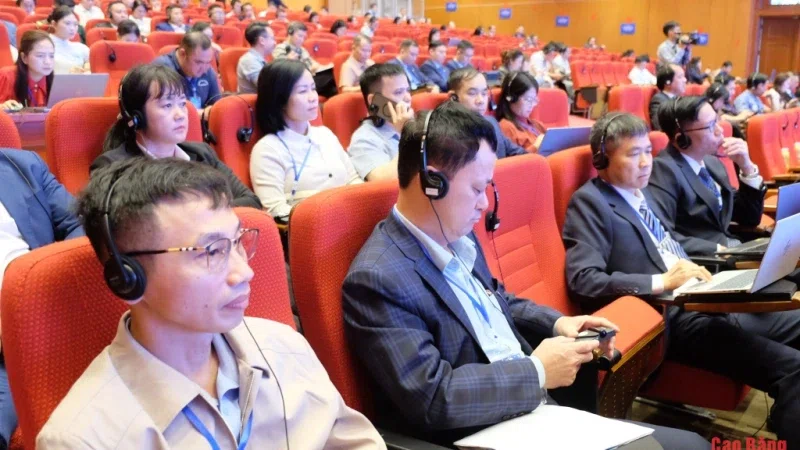
The first thematic discussion session of the International Scientific Conference "Cross-Border Economic and Trade Development" took place on the morning of November 9th at the Provincial Conference Center. The session, titled "Developing Border Economic Zones in the Context of Digital Transformation and Innovation," focused on sharing international experiences and proposing solutions for institutional reform and logistics enhancement in the Cao Bang Border Economic Zone.
Associate Professor, Dr. Ha Van Su, Vice Rector of the University of Commerce, chaired the session, while Dr. Duong Hoang Anh, Head of the Faculty of Economics at the University of Commerce, served as secretary. Experts and scientists from France, China, Laos, and Vietnam presented five research papers regarding cross-border trade, border gate economic development, and regional economic cooperation.
Professor Hervé B. Boismery from Aix-Marseille University presented research on China-Vietnam cross-border trade in electronic products, noting that production and exports rely heavily on imported raw materials and components. Ms. Liu Jiarui from Honghe Academy presented a study on the economic effects of the Yunnan Free Trade Pilot Zone established in 2019.
Dr. Chanthaphone Silipanyo, Deputy Director of the Center for Trade Policy Research at the Institute of Industry, Trade and Energy of the Ministry of Industry and Trade of the Lao People's Democratic Republic, presented research on factors determining comparative advantage in Lao exports. Dr. LI Yiqiang from the Guangxi Academy of Finance and Economics presented a paper on measuring carbon shift in Vietnam-China forestry trade.
Associate Professor, Dr. Nguyen Duy Dat from the University of Commerce presented research on developing the Cao Bang Border Economic Zone into a logistics and tourism center. The study indicated that geographical advantages are insufficient if barriers such as customs procedures, quarantine, and infrastructure persist. He proposed a pilot study of a cross-border free logistics zone in Cao Bang and the simplification of customs procedures.
Delegates discussed leveraging border locations to enhance added value and business capacity. Suggestions for Cao Bang included using automation and artificial intelligence in vehicle inspection and developing logistics services tailored to market demand. The goal is to integrate goods trade, export processing, logistics, and border tourism into an integrated border economic zone model.
Key facts
- The discussion session on developing border economic zones took place on November 9th at the Provincial Conference Center.
- Participants included experts and scientists from France, China, Laos, and Vietnam.
Three perspectives
Neutral
The conference featured five research papers from international experts regarding cross-border trade and economic cooperation.
Positive
The session proposed solutions such as a pilot cross-border free logistics zone in Cao Bang and the use of artificial intelligence for traffic management.
Negative
Research indicated that geographical advantages may not drive formal trade if customs procedures, quarantine, and infrastructure barriers persist.
Your week in news, every Wednesday
The biggest stories of the week for your edition, in your inbox every Wednesday morning, your time. Free, and you can unsubscribe at any time.