

Fossil lizard tail in amber provides direct evidence of ancient defense mechanism
A 99-million-year-old fossil found in Myanmar shows a lizard tail detached through autotomy, a survival strategy used by many living reptiles.
 Science Desk 2 min read
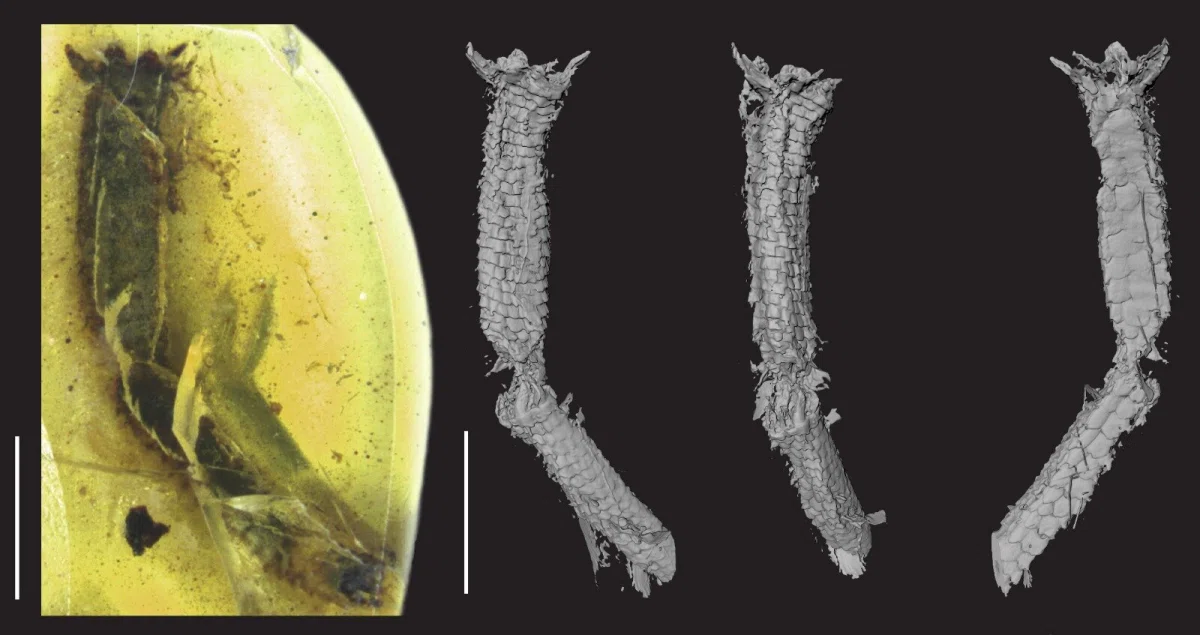
A lizard tail trapped in 99-million-year-old amber from northern Myanmar provides direct evidence of autotomy, a defensive mechanism where a lizard voluntarily drops its tail.
The amber piece is 18 millimeters long, roughly the size of a fingertip.
Researchers used micro-CT scanning at the Volcani Institute to create a three-dimensional reconstruction of the specimen.
The scans revealed a distinctive ring of tissue at the point of detachment that resembles structures seen in tails shed by living lizards.
Although the specimen is identified as a lizard, researchers lack the skull and other skeletal features that would allow for a more secure identification.
Possible affinities include the groups containing today's wall lizards, or, alternatively, slow worms and monitor lizards.
Key facts
- A lizard tail detached approximately 99 million years ago was found in 18-millimeter amber from northern Myanmar.
- Micro-CT scanning revealed a ring of tissue at the detachment point similar to structures in tails shed by living lizards.
- The fossil provides direct evidence that the autotomy survival strategy was operating in lizards 99 million years ago.
Three perspectives
Neutral
The fossilized tail belongs to a lizard from approximately 99 million years ago, though its specific group remains unconfirmed.
Positive
The discovery provides direct evidence of a survival strategy that was already operating in lizards around 99 million years ago.
Negative
Researchers cannot say what prompted the lizard to shed its tail or if the animal survived.
Your week in news, every Wednesday
The biggest stories of the week for your edition, in your inbox every Wednesday morning, your time. Free, and you can unsubscribe at any time.