

Thwaites glacier could double its contribution to sea level rise, study finds
New modeling accounting for tidal movements under the ice suggests the Doomsday Glacier could contribute twice as much to sea level rise by the end of the century as previously projected.
 Climate Desk 2 min read
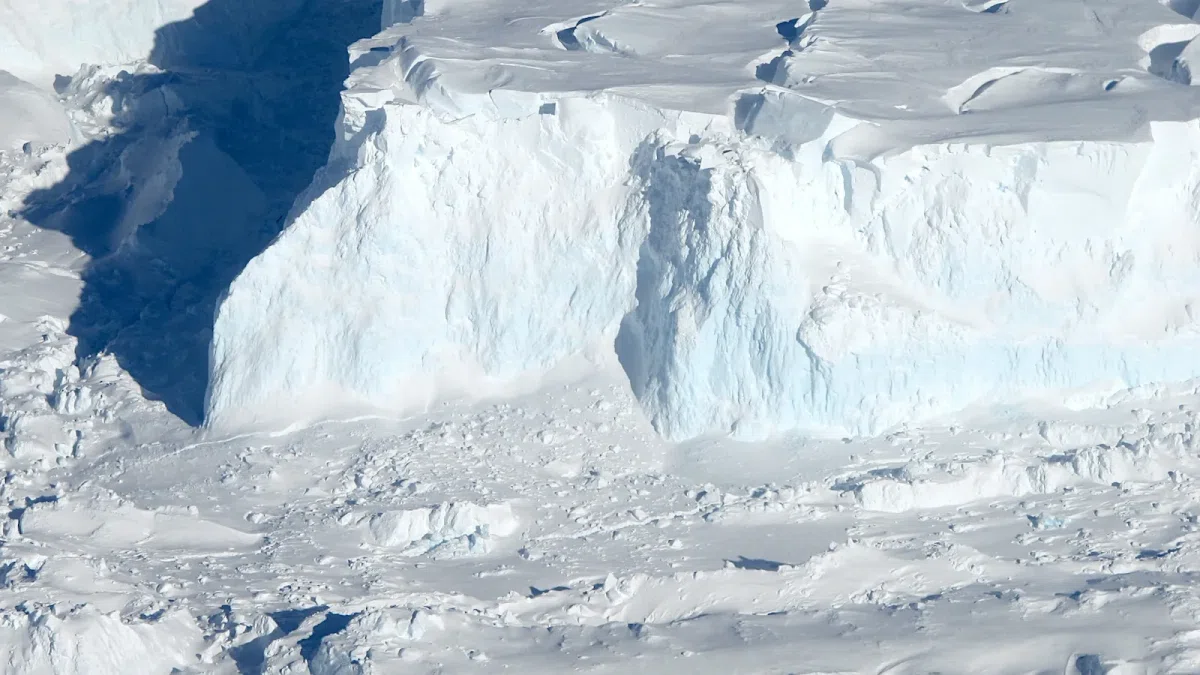
The Thwaites glacier, known as the Doomsday Glacier, could contribute twice as much to sea level rise by the end of the century as previous projections suggested. A new model published in Nature Communications earlier this month accounts for what is happening underneath the glacier to simulate how quickly it may lose ice.
The model includes the grounding zone, where the icy underbelly of Thwaites rests on the seabed. Scientists recently realized this zone is not a fixed boundary but oscillates with the tides. As it bobs up and down, warm water pushes underneath the glacier, creating cracks and miles-long channels that allow more melting.
Mattia Poinelli, a glaciologist at the University of California Los Angeles and lead author of the paper, said the model solves a specific and important piece of the puzzle. The model showed Thwaites could become permanently unpinned from the seafloor as early as 2038, with a 60 percent chance this could happen by the end of the century.
If the climate remains as warm as it is now, the model shows Thwaites would be on track to add 3 centimeters of sea level rise by the end of the century. This doubles the projections made by previous models. Thwaites currently contributes about 4 percent to sea level rise, amounting to some 10 centimeters over the past three decades.
The melting of Thwaites has already forced coastal communities in places like the Solomon Islands and Senegal to move to higher ground. If Thwaites were to succumb entirely, the whole interior of the West Antarctic ice sheet might follow, potentially raising sea levels by as much as 10 feet.
Rosie Williams, an ice sheet modeler at the British Antarctic Survey and lead author of a separate study, said lowering greenhouse gas emissions could protect other glaciers. She said the more we can slow it down, the longer we have to adapt to any change that is coming.
Key facts
- Thwaites could contribute twice as much to sea level rise by the end of the century as previously projected.
- The glacier could become permanently unpinned from the seafloor as early as 2038.
- Thwaites holds enough ice to push the planet's coastlines up 2 feet.
Three perspectives
Neutral
New modeling shows that tidal oscillations in the grounding zone may accelerate the melting of the Thwaites glacier.
Positive
Lowering greenhouse gas emissions could protect other glaciers around Antarctica and provide more time to adapt to changes.
Negative
The Thwaites glacier could contribute twice as much to sea level rise by the end of the century as previously projected, potentially forcing coastal communities to move to higher ground.
Your week in news, every Wednesday
The biggest stories of the week for your edition, in your inbox every Wednesday morning, your time. Free, and you can unsubscribe at any time.