

Martian dust may be less abrasive than lunar dust, study finds
Analysis of spacesuit material swatches on NASA's Perseverance rover suggests Martian particles are smoother than those on the moon, though they pose risks due to their fine size and toxicity.
 Space Desk 2 min read
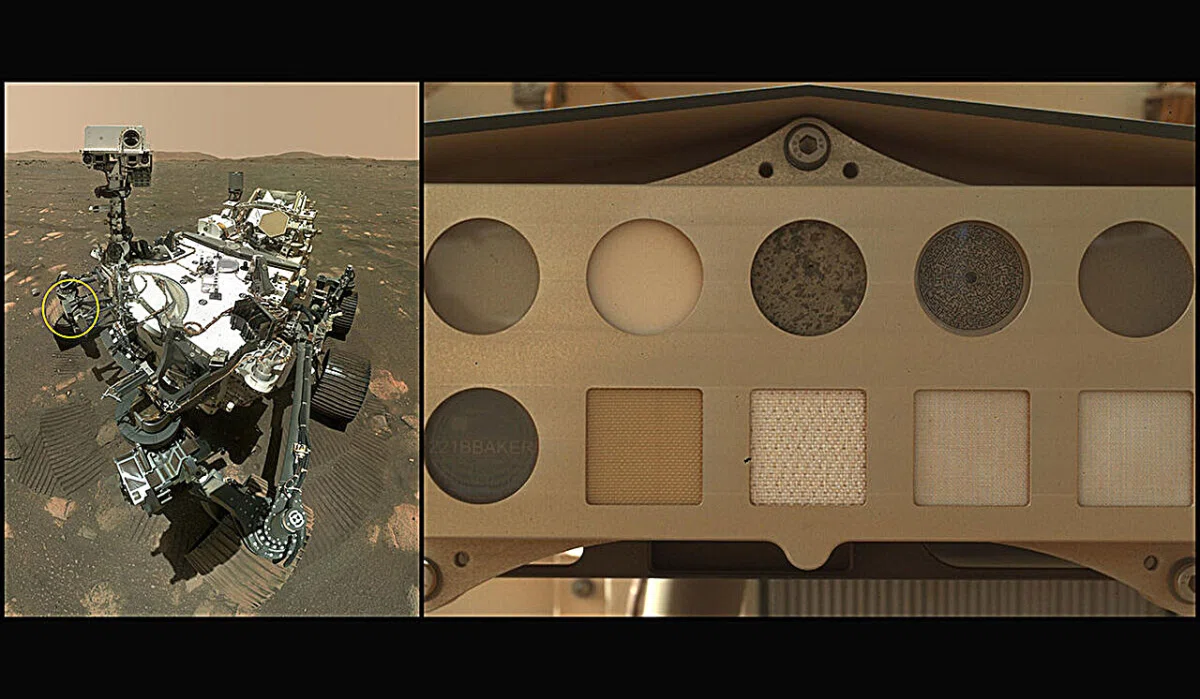
Small swatches of spacesuit material carried by NASA's Perseverance rover have helped scientists assess potential damage from Martian dust. The swatches showed little visible wear after 1,645 Martian days. Closer inspection revealed that Martian particles are much smoother than the jagged grains found on the moon, suggesting they may be less likely to scratch equipment or irritate human lungs.
Scott VanBommel, a research assistant professor at WashU Arts & Sciences, said the particles in the Martian atmosphere have been blowing in the wind for potentially billions of years, so they tend to be well rounded, like pebbles in a river. However, Martian dust can be exceptionally fine. Some particles measured as small as 100 nanometers across.
The study, published in the Proceedings of the National Academy of Sciences, examined how dust interacts with the swatches and other materials, including Teflon. Abigail Knight, a staff scientist, helped conceptualize and conduct the analysis. Data from the rover's PIXL instrument also allowed researchers to analyze the chemical composition of the particles.
Unlike lunar dust, Martian material contains perchlorates and other potentially toxic compounds, and is enriched in sulfur, iron and silica. While brief exposure may not seriously threaten health, the dose and duration matter. Engineers will need to account for these microscopic hazards when designing habitats, spacesuits and air filters.
Planners of future Mars missions have reason to prepare for dust. On the Apollo missions, lunar dust scratched visors, degraded spacesuits, and contaminated air with particles that entered astronauts' lungs. VanBommel said that while dust will be a challenge, it is something that can be prepared for and overcome.
Key facts
- Martian dust particles are smoother and less abrasive than jagged lunar dust.
- Some Martian dust particles are as small as 100 nanometers across.
- Martian dust contains perchlorates and is enriched in sulfur, iron and silica.
Three perspectives
Neutral
Researchers used spacesuit material swatches on the Perseverance rover to study how Martian dust affects equipment and potential human health.
Positive
The finding that Martian dust is less abrasive than lunar dust is an encouraging result for future visitors.
Negative
Martian dust can be exceptionally fine and contains potentially toxic compounds like perchlorates.
Your week in news, every Wednesday
The biggest stories of the week for your edition, in your inbox every Wednesday morning, your time. Free, and you can unsubscribe at any time.