

IIT Madras faculty part of breakthrough in molecular machine research
Researchers demonstrated how electric current can drive the rotation of a single molecule to increase electrical conduction.
 Science Desk 2 min read
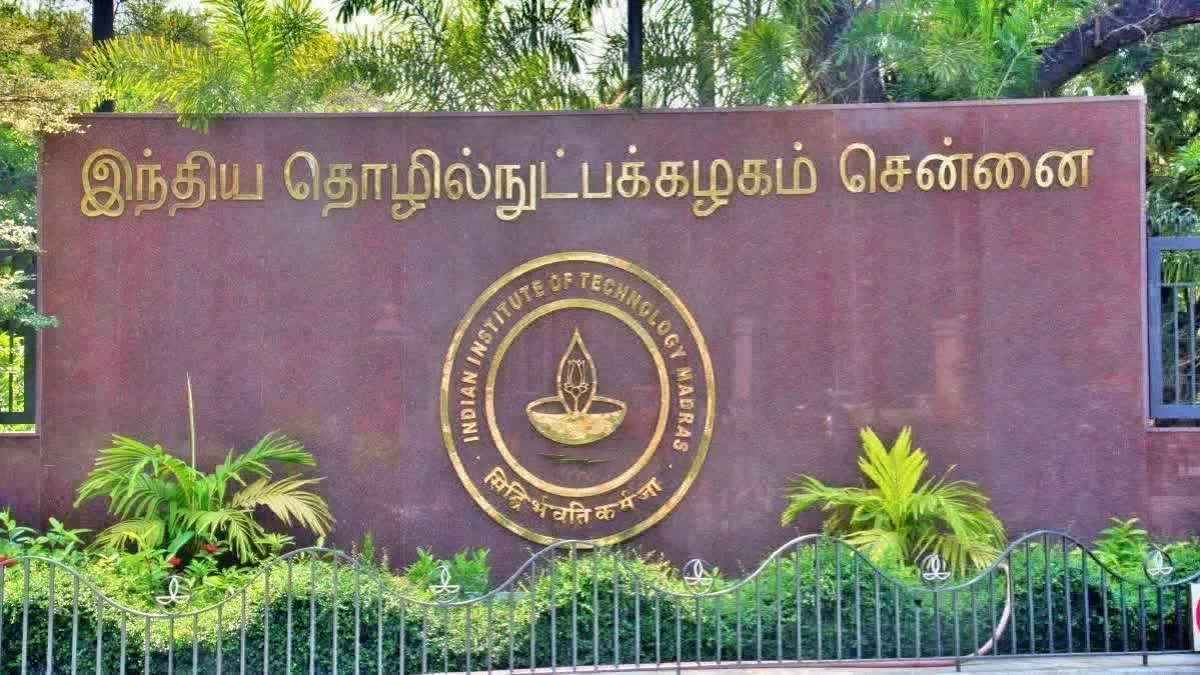
An IIT Madras faculty member is part of an international research team that has made a breakthrough in fundamental research at the intersection of physics, chemistry and nanotechnology. The study, published in the journal Nature, shows how electrically driven molecular rotation could help guide the design of future nanoscale switches and electronic components.
The researchers demonstrated a mechanism in which molecular motion and electrical conduction influence each other at the atomic scale. They showed a molecular machine in which an electric current drives the directional rotation of a single molecule, and this rotation can increase electrical current through the molecule. During this rotation, the molecule passes through configurations that allow electrons to flow more readily, increasing the current through the intact molecular junction by up to approximately 100-fold.
Anil Kumar Singh, an Assistant Professor in the Atomic-Scale Quantum Devices Laboratory at IIT Madras, is a corresponding author and the principal experimental contributor to the study. Singh, who designed and performed the single-molecule break-junction experiments during his research tenure at the Weizmann Institute of Science in Israel, said that molecular motion can facilitate the passage of electrons through the molecule.
The team used a molecular rotor based on helicene, a molecule with a spiral structure resembling a tiny screw. Using a mechanically controllable break junction, the researchers suspended a single helicene molecule between two gold electrodes. When a voltage was applied, the electrical current drove the molecule through a cyclic sequence of configurations. Reversing the voltage polarity reversed the sequence, indicating that the direction of molecular rotation could be controlled electrically.
This is a fundamental proof-of-principle demonstration, rather than a technology ready for practical use, Singh said. The experiments were performed at cryogenic temperatures, and further research will be needed to establish reliable operation under practical conditions. Potential applications include molecular-scale switches, current-modulating elements and systems that enable directional transport near surfaces.
Key facts
- Anil Kumar Singh from IIT Madras is a corresponding author and the principal experimental contributor to the study.
- The research demonstrated that molecular rotation can increase electrical current through a molecule by up to approximately 100-fold.
- The study involved collaborators from India, Israel, Germany, Denmark and China.
Three perspectives
Neutral
The research demonstrates a fundamental mechanism where electrical current drives molecular rotation at the atomic scale.
Positive
The findings provide a foundation for exploring future molecular-scale switches and current-modulating elements.
Negative
The experiments were performed at cryogenic temperatures and the technology is not yet ready for practical use.
Your week in news, every Wednesday
The biggest stories of the week for your edition, in your inbox every Wednesday morning, your time. Free, and you can unsubscribe at any time.