

Invisible companion triggers repeated outbursts from massive star AT 2016blu
NASA's Chandra X-ray Observatory observations suggest a black hole or neutron star is pulling material from the unstable star every 113 days.
 Space Desk 2 min read
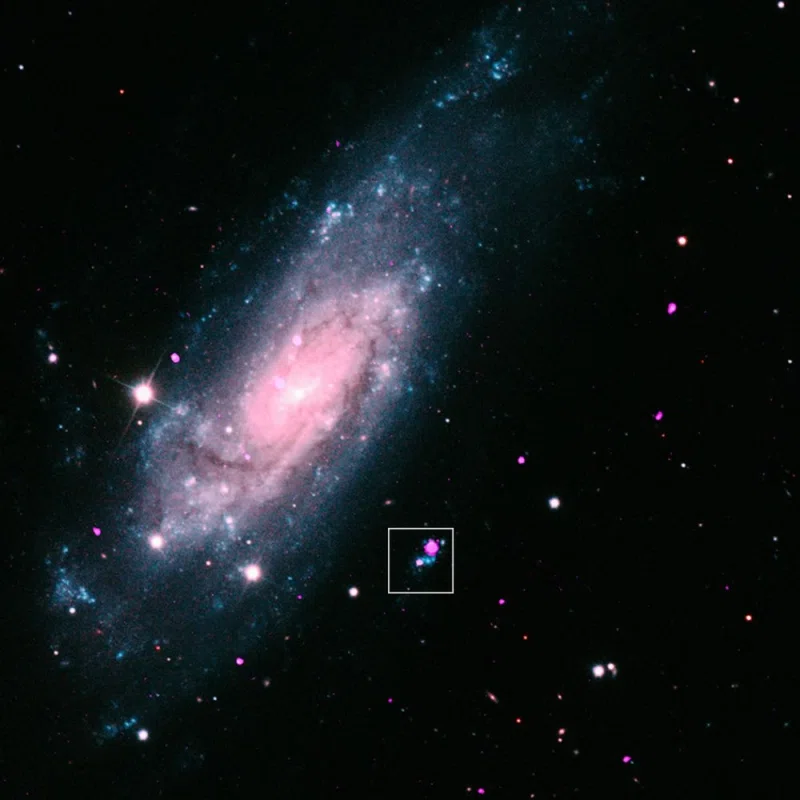
Observations from NASA’s Chandra X-ray Observatory indicate that recurring bright outbursts from the massive star AT 2016blu may be caused by an invisible compact companion. This companion, which may be a stellar-mass black hole or a neutron star, moves in an elliptical orbit with a period of 113 days.
Astronomers estimate the mass of this star is at least 33 times that of the Sun.
During its closest approach in an oval-shaped orbit, the companion's gravity pulls material away from the massive star. This material forms a hot accretion disk around the black hole or neutron star, emitting X-rays. The X-ray radiation heats a dense cloud of gas previously ejected by the star, causing it to shine brightly in the visible range.
The star's behavior was initially confusing because its extreme spikes in brightness resemble supernova explosions. However, because the star survives these outbursts, it is referred to as a supernova impostor. Between 2012 and 2026, astronomers detected at least 27 such outbursts occurring roughly every 113 days.
“For 15 years, astronomers have been watching this star get really bright and then dim again on a regular basis,” said lead author Mojgan Aghakhanloo of the University of Virginia. “Until we were able to get Chandra data at the right time, we couldn’t figure out what was making this happen.”
Key facts
- AT 2016blu is a luminous blue variable star with at least 33 solar masses.
- The star undergoes outbursts approximately every 113 days.
- The outbursts are likely triggered by a companion black hole or neutron star in an elliptical orbit.
Perspectives
Neutral
Astronomers have identified a compact companion, likely a black hole or neutron star, as the trigger for repeated outbursts from the massive star AT 2016blu.
Positive
The use of Chandra X-ray data allowed astronomers to finally understand the cause of the star's confusing, repeated eruptions.
Your week in news, every Wednesday
The biggest stories of the week for your edition, in your inbox every Wednesday morning, your time. Free, and you can unsubscribe at any time.