

Uganda and Russia call for stronger cooperation ahead of Moscow summit
The call for enhanced ties in education, research, trade and technology came during a Makerere University exhibition examining historical ties.
 Politics Desk 3 min read
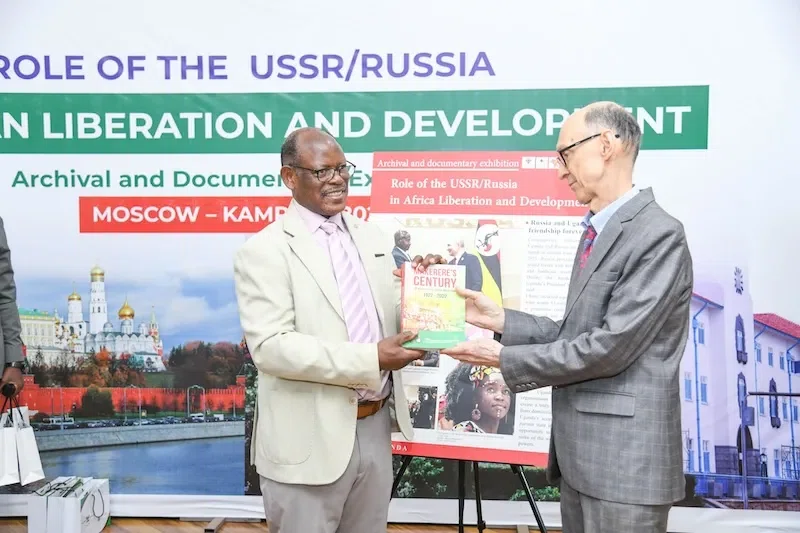
Uganda and Russia have called for stronger cooperation in education, research, trade and technology as the two countries prepare for the third Russia-Africa Summit scheduled for Moscow on October 28 and 29.
The call came during an exhibition at Makerere University on October 23, which examined the historical role of the former Soviet Union and Russia in African liberation and development. The exhibition was organised by Makerere University’s College of Humanities and Social Sciences in partnership with the Russian State University for the Humanities. It brought together diplomats, academics, government officials and students to reflect on Uganda’s historical ties with Russia and explore opportunities for future cooperation.
Sergey Lobanov, the Chargé d’Affaires of the Russian Federation in Uganda, said the exhibition offered an opportunity to revisit Russia’s historical relationship with African countries while strengthening cooperation in areas of mutual interest. He said the Soviet Union played a key role in the adoption of the Declaration on the Granting of Independence to Colonial Countries and Peoples 65 years ago. Lobanov added that Moscow subsequently contributed to the development of newly independent African states, including the establishment of national economies, education systems and healthcare services.
Michael Karugaba, representing the permanent secretary of the ministry of Foreign Affairs, Vincent Waiswa Bagiire, said the relationship had evolved from political solidarity during the liberation era to cooperation aimed at supporting economic transformation. Karugaba said Uganda intended to use the Moscow summit to follow up on areas of cooperation, including investment, energy, information and communication technology, human capital development, scholarships and academic exchanges. He also pointed to Uganda’s admission as a BRICS partner country in January 2025 as another avenue for strengthening its international economic partnerships.
Prof Vera Zabotikina, acting vice-rector for International Cooperation at the Russian State University for the Humanities, said the exhibition was part of a project supported by Russia’s ministry of Science and Higher Education. She noted that in the late 1960s and early 1970s, Soviet specialists designed steam mills and equipped a plant with heavy industrial textile machinery in Lira. The Soviet Union also constructed and equipped an agricultural training institution in the early 1970s, which was later upgraded in 2007 and became the administrative headquarters of Busitema University.
Mary Frances Atima, chief education officer for Education Standards and Quality Assurance at the ministry of Education and Sports, said the Russian Government provides a scholarship quota of 50 Ugandan students per academic year. Makerere University vice-chancellor Prof Barnabas Nawangwe said the Soviet Union supported liberation movements in several African countries, including Ghana, Guinea, Congo, Angola, Mozambique, Namibia, Zimbabwe and South Africa. He also noted that Ugandans trained in the Soviet Union returned to work as doctors, engineers, agronomists, teachers and administrators.
Key facts
- Uganda and Russia are preparing for the third Russia-Africa Summit in Moscow on October 28 and 29.
- Russia provided military equipment and hardware worth $53 million to Uganda in 2025.
- The Russian Government provides a scholarship quota of 50 Ugandan students per academic year.
Three perspectives
Neutral
Uganda and Russia are seeking to expand cooperation in sectors such as trade, technology, and education ahead of a summit in Moscow.
Positive
The two nations aim to elevate bilateral relations through increased investment, energy cooperation, and academic exchanges.
Negative
The historical relationship involved the Soviet Union supporting liberation movements in various African countries to break free from colonial rule.
Your week in news, every Wednesday
The biggest stories of the week for your edition, in your inbox every Wednesday morning, your time. Free, and you can unsubscribe at any time.