

King Charles acknowledges history of slavery in Guyana
The King held a moment of reflection at Independence Park in Georgetown, the site of executions following the 1823 Demerara Slave Rebellion.
 World Desk 2 min read
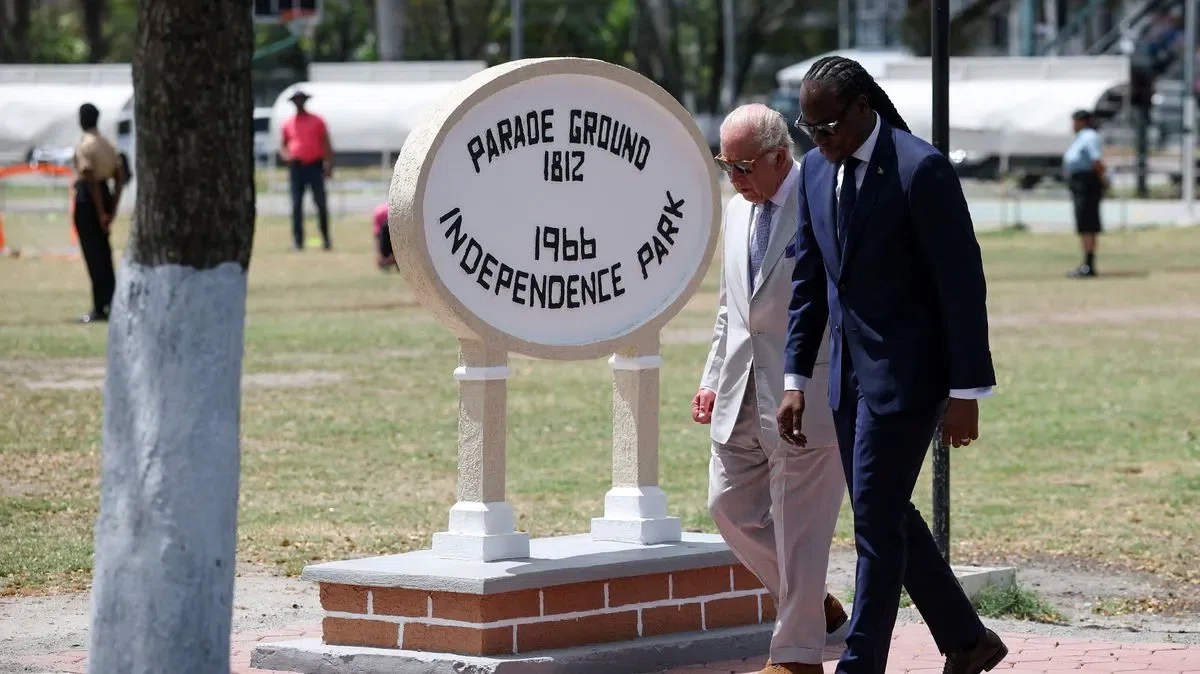
King Charles took part in a moment of reflection at Independence Park in Georgetown, Guyana, to acknowledge the country's history of slavery and resistance. He stood at the site where enslaved Africans were publicly executed following the Demerara Slave Rebellion of 1823. The King was accompanied by Guyana's Minister of Culture, Steven Jacobs, who showed him a plaque commemorating those condemned to death at the former Parade Ground.
The 1823 uprising began at the Success plantation, owned by Sir John Gladstone, and was signaled by Jack Gladstone ringing the plantation bell at 6:30pm on August 18, 1823. While Jack's father, Quamina, had urged a peaceful strike, the rebellion was crushed with brutal force and hundreds were killed. Quamina was killed on September 16 and his body was hanged in chains outside the plantation as a warning. Quamina is now one of Guyana's national heroes.
The King's visit comes as Guyana marks its 60th anniversary of independence from Britain. It also occurs ahead of the Commonwealth Heads of Government Meeting in Antigua and Barbuda, where Caribbean leaders are expected to press demands for reparations for slavery and colonialism. At Umana Yana, approximately 30 protesters met the King with posters demanding reparations.
During his visit, the King also visited Promenade Gardens, where he was greeted by the Mayor of Georgetown, Alfred Mentore. He heard about conservation projects, including a collaboration between Kew Gardens and Guyana involving the Victoria amazonica water lily.
Key facts
- The King visited Independence Park in Georgetown to acknowledge the history of the 1823 Demerara Slave Rebellion.
- Guyana's President Irfaan Ali stated that while the King has recognised slavery as the darkest days in human history, an apology is the next step.
- Protesters at Umana Yana demanded reparations for Caribbean communities affected by slavery.
Three perspectives
Neutral
King Charles visited Georgetown, Guyana, to acknowledge the history of slavery and resistance at the site of the 1823 Demerara Slave Rebellion.
Positive
The King's Foundation is assisting with planning projects to help Georgetown become one of the most sustainable cities in South America and the Caribbean.
Negative
The King's visit was shadowed by calls for an apology for slavery and was met by protesters demanding reparations.
Your week in news, every Wednesday
The biggest stories of the week for your edition, in your inbox every Wednesday morning, your time. Free, and you can unsubscribe at any time.