

Paleontologists find fruit-eating dinosaur in North America
The newly identified Infernogallus jamesi was a turkey-sized, feathered creature that used a unique chewing mechanism to mash soft fruit.
 Science Desk 2 min read
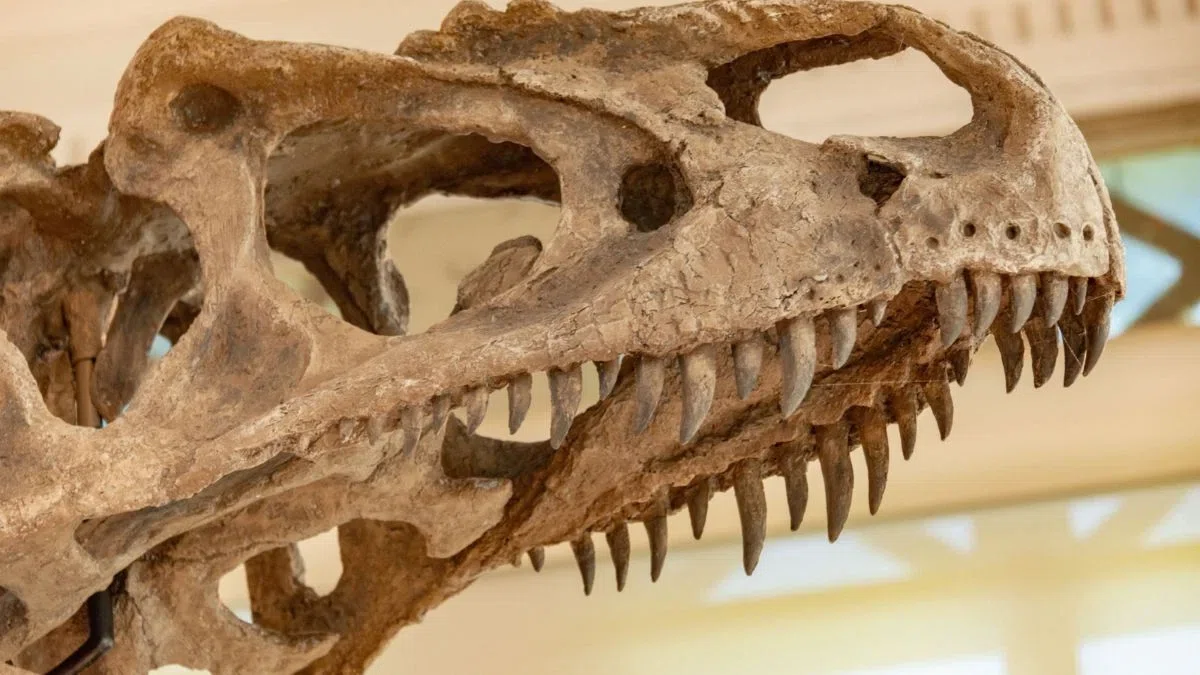
An international team of paleontologists has discovered a type of dinosaur that preferred eating fruits instead of meat or grass. The creature, named Infernogallus jamesi, meaning “hell chicken”, was a feathered bird that lived in North America around 66 million years ago during the end of the Cretaceous period.
The dinosaur belonged to a group of toothless, bird-like caenagnathids that weighed approximately 12 kg. Scientists predict the animal was the size of a turkey and is the first of its kind to have developed chewing muscles to mash soft food.
Researchers from Stony Brook University, the Royal Ontario Museum, and the North Dakota Geological Survey studied a rare fossil of a nearly complete skull and parts of the skeleton. Using CT scans, the team reconstructed the skull to digitally examine the bones and jaw muscle movement.
Unlike the up and down bite of many dinosaurs, Infernogallus jamesi moved its lower jaw backwards and forwards while chewing. The unusual shape of the mouth changed the position of its chewing muscles, a mechanism that resembles the feeding of today's fruit eating parrots.
Co-author Thomas Dudgeon, a postdoctoral research fellow, said the anatomy of Infernogallus is bizarre among dinosaurs.
During the Cretaceous period, flowering plants became more popular, providing fruits as an alternative food source. Animals eating these fruits helped spread seeds to allow plants to grow in new areas. Senior author David Evans said the discovery shows there is still much to learn about dinosaurs.
Key facts
- The dinosaur Infernogallus jamesi lived in North America approximately 66 million years ago.
- The species was a feathered, toothless caenagnathid weighing about 12 kg.
- The dinosaur used a backwards and forwards jaw movement to mash soft fruit.
Three perspectives
Neutral
An international team of paleontologists identified a turkey-sized dinosaur that specialized in eating fruit.
Positive
The discovery of the strange skull reveals surprising insights into dinosaur evolution and feeding specialization.
Negative
Complete remains of small dinosaurs like Infernogallus are very rare in the fossil record.
Your week in news, every Wednesday
The biggest stories of the week for your edition, in your inbox every Wednesday morning, your time. Free, and you can unsubscribe at any time.