

 Australia
Euclid mission releases first major dataset of 900 million galaxies
The European Space Agency's Euclid telescope has provided 1.7 petabytes of data to help scientists map the cosmic web and study dark matter and dark energy.
 Space Desk 3 min read
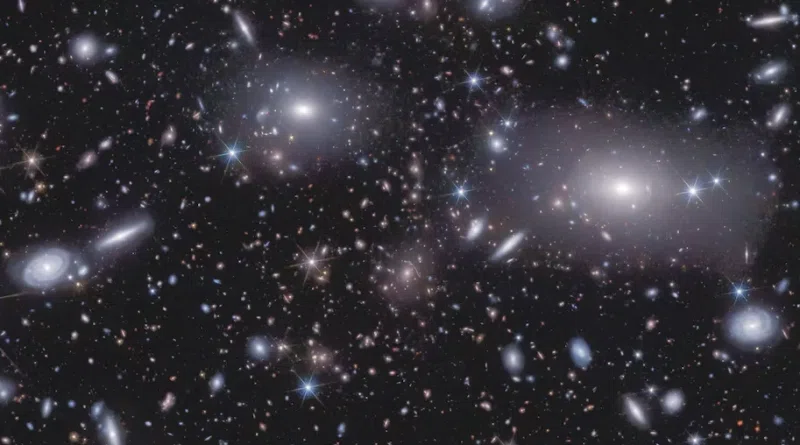
The European Space Agency has released its first large collection of data from the Euclid telescope mission, including observations of more than 900 million galaxies. The data, released on Thursday, covers a survey of the sky equal to about 9,500 times the size of the moon as viewed from Earth. This release encompasses around 13 months of observations, totaling 1.7 petabytes of data.
The dataset covers 14% of the total sky area that Euclid is due to survey over six years. It includes more than 60 million potential quasars, which are brilliant cores of galaxies powered by supermassive black holes. The mission aims to complete the largest-ever three-dimensional atlas of the cosmos, spanning more than a third of the sky, in 2031.
Astrophysicist Valeria Pettorino, ESA's Euclid project scientist, said the mission will measure the distance of galaxies to provide a third dimension, showing where they are in space and time across 10 billion years. Euclid will reconstruct the cosmic web, a network of galaxy clusters and filaments, to study how it has grown over time. The configuration of this web depends on the properties of dark energy and dark matter.
The new data includes about 15,000 strong gravitational lens candidates, exceeding the total number discovered in the previous half century. Natalie Lines, a doctoral student in astrophysics at the University of Portsmouth, said gravitational lenses act as nature's weighing scales because the strength of light bending reveals how much matter a galaxy contains. Prof Andy Taylor of the University of Edinburgh noted that while other surveys exist, none have the detail and information content of Euclid.
Dark matter is an invisible material that may make up about 27% of the cosmos, while dark energy may account for 68%. Ordinary matter, including stars and planets, represents about 5% of the universe's contents. Scientists use gravitational lensing to study the distribution of dark matter, as the presence of dark matter increases the gravitational influence of a galaxy.
The data release will be completed next year with the first results on dark energy and dark matter. By studying strong gravitational lensing, scientists may be able to rule out different theories on the nature of dark matter. Experts expect to discover an estimated 170,000 strong gravitational lenses by the end of the mission.
Key facts
- The Euclid data release includes observations of more than 900 million galaxies and 60 million potential quasars.
- The dataset totals 1.7 petabytes and covers 14% of the total sky area Euclid is scheduled to survey.
- The mission aims to create a three-dimensional atlas of the cosmos by 2031.
Perspectives
Neutral
The European Space Agency has released 1.7 petabytes of data from the Euclid telescope covering 900 million galaxies and 14% of its target sky area.
Positive
The release includes about 15,000 strong gravitational lens candidates, exceeding the total number discovered in the previous half century.
Your week in news, every Wednesday
The biggest stories of the week for your edition, in your inbox every Wednesday morning, your time. Free, and you can unsubscribe at any time.