

India and China debate future of agricultural input sourcing
Industry experts at the AgriBusiness Global Trade Summit discussed whether India or China will shape the future of the sector through cost, innovation, and supply chain resilience.
 Business Desk 2 min read
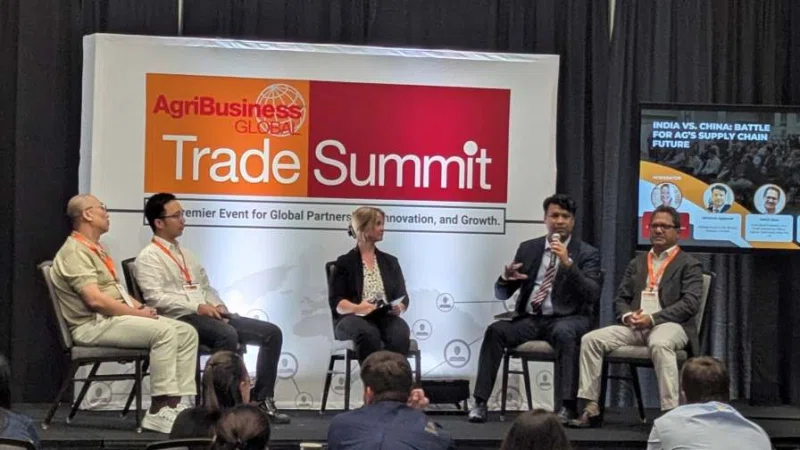
Representatives from India and China debated which global powerhouse will define the future of agricultural input sourcing at the AgriBusiness Global Trade Summit. The session explored how cost, innovation, regulation, and supply chain resilience will shape the industry.
The China team included David Li, Vice President of SPM Biosciences, and Kevin Li, General Manager of Fuhua Crop Protection Division of Sichuan Leshan Fuhua Tongda Agro-chemical Technology Co., Ltd.
While the industry has focused on cost in recent years, panelists suggested a shift toward companies that ensure trust, intellectual property protection, reliability, and long-term partnerships. Abhishek Aggarwal said the last decade was about who is the best or cheapest supplier, but the next decade is about who is the most trusted.
David Li described a trust building model consisting of ability, kindness to help farmers, and risk taking to understand what farmers need. Regarding geopolitical issues, Abhijit Bose noted that the U.S.-Iran conflict impacts the world and said it is better to adapt to such geopolitical scenarios.
The ability to use artificial intelligence will become a competitive differentiator in the future. While India has grown its capacity for AI in manufacturing, R&D, and logistics, China currently has the upper hand in AI for ag chem and the development of new molecules.
Key facts
- India and China representatives debated the future of agricultural input sourcing at the AgriBusiness Global Trade Summit.
- The industry is moving from a focus on being the cheapest supplier to being the most trusted.
- China currently holds an advantage in using artificial intelligence for ag chem and developing new molecules.
Three perspectives
Neutral
Industry experts at the AgriBusiness Global Trade Summit discussed the competition between India and China regarding agricultural input sourcing.
Positive
The industry is gravitating toward companies that prioritize trust, reliability, and long-term partnerships.
Negative
Geopolitical issues, such as the U.S.-Iran conflict, continue to impact global supply chains.
Your week in news, every Wednesday
The biggest stories of the week for your edition, in your inbox every Wednesday morning, your time. Free, and you can unsubscribe at any time.