 United States
ULA Vulcan rocket to return to flight with six boosters
The mission will deploy 40 Amazon Leo satellites and features an improved nozzle design to address previous booster failures.
 Space Desk 2 min read
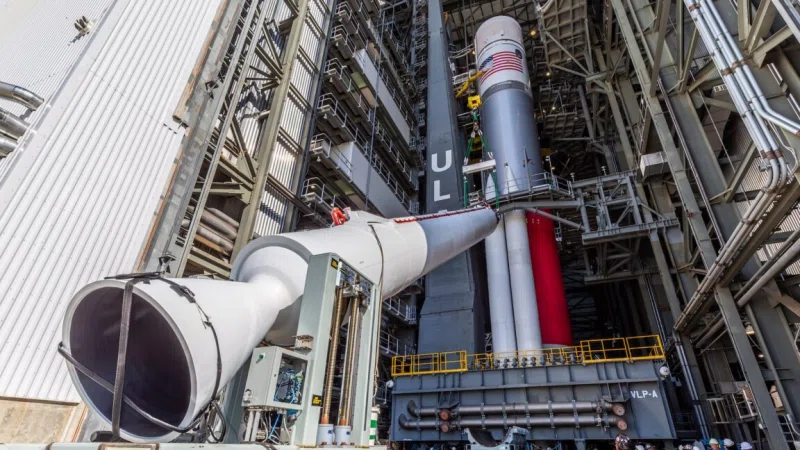
United Launch Alliance is set to return its Vulcan rocket to flight on Friday the 13th. The mission will lift off from Cape Canaveral Space Force Station, Florida, though the launch date is pending range approval. This launch will be the first to utilize a full complement of six solid rocket boosters.
The mission will launch 40 satellites for the Amazon Leo broadband constellation, which is the first of 38 Vulcan flights Amazon has booked to deploy the bulk of its network. The flight will also debut an extended payload fairing to accommodate the satellite stack and a shortened Centaur upper stage optimized for low-Earth orbit missions.
The return to flight is critical for ULA after its flagship rocket suffered nozzle failures on its solid rocket boosters during two of its first four missions, most recently in February. While the rocket overcame those failures to complete its missions, officials at the US Space Force lost confidence in Vulcan.
ULA engineers said they have identified several potential contributors to the February anomaly and have mitigated them through design and process improvements to the nozzle. The upcoming launch will utilize the improved nozzle design, and additional testing and analysis will continue in parallel with the mission.
Space Force officials will closely scrutinize the return-to-flight mission. Gen. Eric Zarybnisky, the chief rocket buyer at Space Systems Command, said the military wants to see data from commercial flights on the Vulcan rocket before clearing ULA to resume national security launches.
The Pentagon has entrusted ULA’s Vulcan rocket for roughly half of its major launches through the early 2030s. At least two Amazon Leo missions are on the Vulcan launch schedule before it flies another national security mission, which could occur early next year.
Key facts
- The Vulcan launch will be the first to use a full complement of six solid rocket boosters.
- The mission will deploy 40 satellites for the Amazon Leo broadband constellation.
- ULA engineers have implemented design and process improvements to the nozzle to mitigate previous booster anomalies.
Three perspectives
Neutral
The Vulcan rocket is scheduled to return to flight on Friday the 13th to launch 40 Amazon Leo satellites from Cape Canaveral Space Force Station.
Positive
ULA engineers have made strides in understanding previous booster anomalies and have implemented improved nozzle designs for the upcoming mission.
Negative
The Space Force lost confidence in the Vulcan rocket after it suffered nozzle failures on its solid rocket boosters during two of its first four missions.
Your week in news, every Wednesday
The biggest stories of the week for your edition, in your inbox every Wednesday morning, your time. Free, and you can unsubscribe at any time.