

Monash University researchers expand diamond quantum sensor bandwidth to 48MHz
Techniques using heterodyne mixing and magnetic gradients achieved a tenfold increase in sensing speed for diamond nitrogen-vacancy centres.
 Science Desk 2 min read
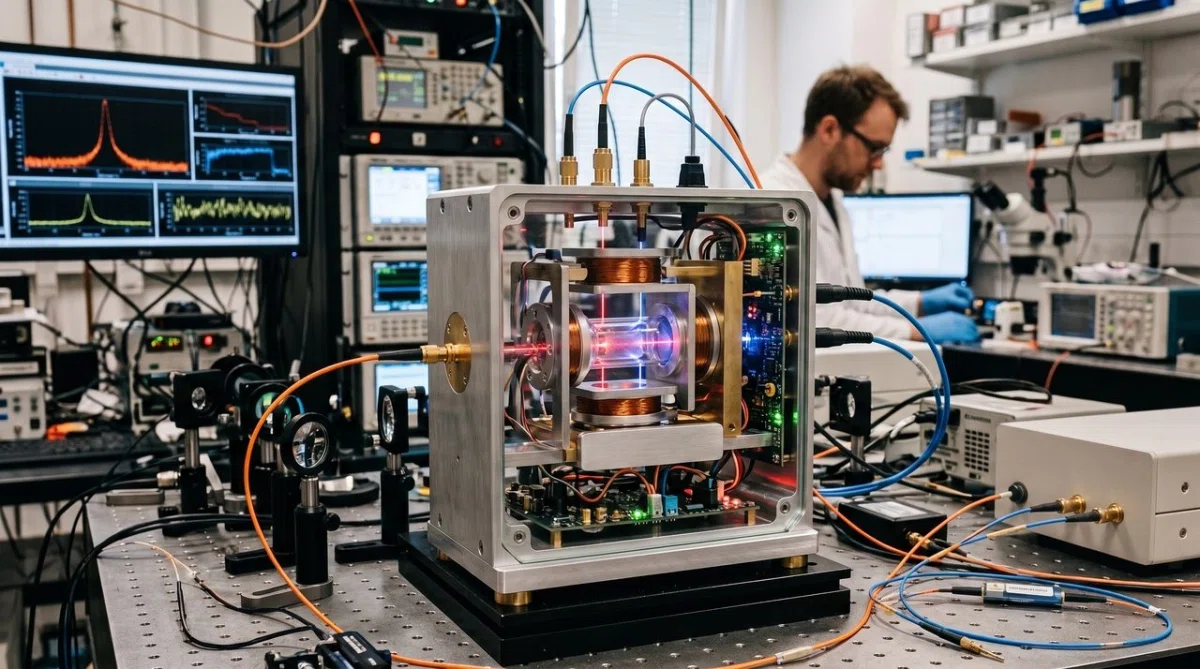
Researchers at Monash University have expanded the bandwidth of magnetic quantum sensors using diamonds containing nitrogen-vacancy centres. The team achieved a single resonance bandwidth of 48MHz, which is over ten times greater than previous limitations at the MHz scale.
The team employed heterodyne mixing, a technique similar to tuning two radio frequencies together to create new ones for easier analysis, alongside strong microwave driving under a magnetic gradient. This method allowed the sensors to detect rapidly fluctuating information, potentially enabling use in advanced communication systems.
The researchers achieved an instantaneous bandwidth of up to 48MHz with a sensitivity of 548 pT/sqrt(Hz). However, increasing the detection speed to this level reduced the peak sensitivity to 8.5 nT/sqrt(Hz).
The reported sensitivity figures were obtained without static fields beyond ambient equipment noise around 100 μT. Demonstrating performance in real-world shielded scenarios remains an ongoing challenge.
The expanded bandwidth could accelerate data acquisition rates for precise navigation systems and secure communication. Further refinement is needed to balance increased responsiveness with signal clarity.
Key facts
- Monash University researchers achieved a 48MHz bandwidth for diamond nitrogen-vacancy centre sensors.
- The technique used heterodyne mixing and strong microwave driving under a magnetic gradient.
Three perspectives
Neutral
Researchers expanded the bandwidth of diamond-based quantum sensors to 48MHz using heterodyne mixing and magnetic gradients.
Positive
The expanded bandwidth allows for the detection of rapidly fluctuating information and could accelerate data acquisition for secure communications.
Negative
Increasing the detection speed to 48MHz demonstrably reduced the peak sensitivity of the sensors.
Your week in news, every Wednesday
The biggest stories of the week for your edition, in your inbox every Wednesday morning, your time. Free, and you can unsubscribe at any time.