

Seaweed farming provides new income for West Kwaio families
Local farmers in Malaita Province are turning to seaweed cultivation as an alternative livelihood to traditional land-based activities and fishing.
 Business Desk 2 min read
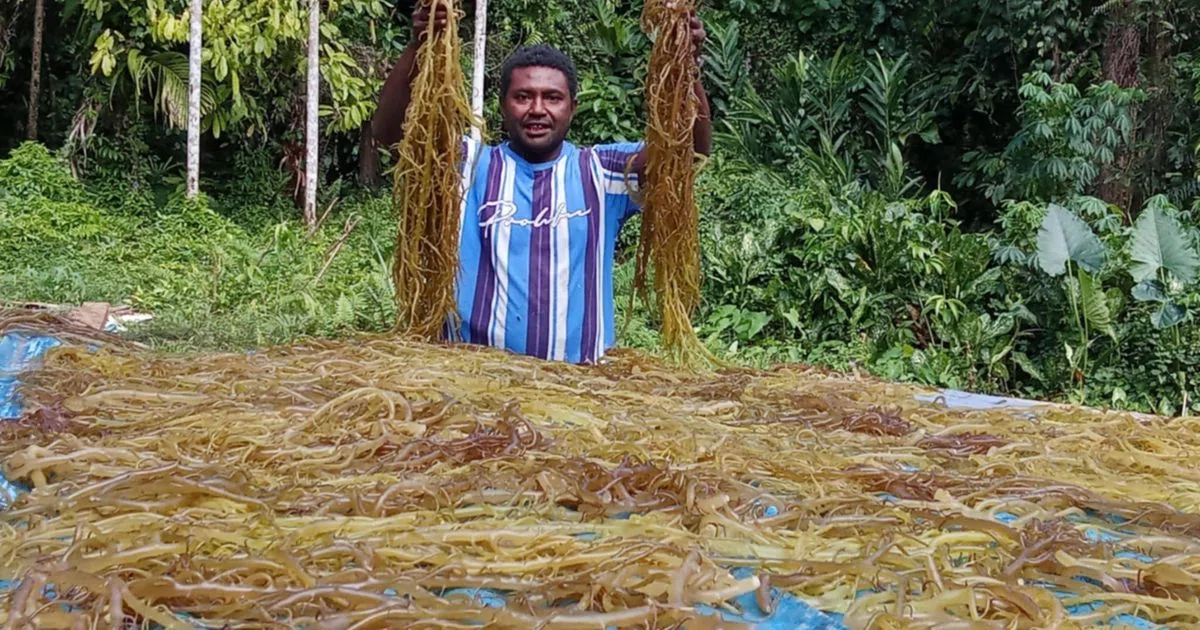
Seaweed farming is emerging as a new source of income for families in West Kwaio, Malaita Province, offering coastal communities an alternative livelihood and opportunities to improve household earnings. Introduced to the area last year, the industry is attracting growing interest among local farmers in 2026, supported by the Taba’a Sanctuary Seaweed Association.
Vincent Sudafi, a 40-year-old father of nine from West Kwaio, said seaweed farming offers the potential to earn a better income compared with some traditional land-based activities and fishing. He began farming seaweed in June 2026 after receiving 100 nursery plants from his cousin. He has since established three long lines and hopes to expand his farm to six.
Sudafi has harvested approximately 20 lines of seaweed from his first planting, noting that seaweed generally takes about six weeks to grow in the sea before it is ready for harvesting. He is currently focusing on drying his harvest, a process that takes about three days during hot and sunny weather but can take longer during rainy and cooler conditions. The Taba’a Seaweed Association currently offers around SBD7 per kilogram.
Despite the opportunities, farmers face challenges including a shortage of ropes, such as two-millimetre, six-millimetre and 10-millimetre ropes, and limited equipment like boats and canoes. Strong winds can cause seaweed lines to become tangled or break, and farmers also deal with white growth appearing on plants. Sudafi said further technical advice and assistance from the Ministry of Fisheries would help address these problems.
Sudafi advised those entering the industry to remain committed and sacrifice time to look after the farms. He also cautioned against establishing farms too close to reefs, where fish, turtles and other marine animals can damage or feed on the seaweed. He aims to sell his current harvest to buy more ropes so he can expand his plantation in the future.
Key facts
- Seaweed farming is providing an alternative income source for families in West Kwaio, Malaita Province.
- The Taba’a Sanctuary Seaweed Association currently offers approximately SBD7 per kilogram for seaweed.
- Farmers face challenges including shortages of ropes, limited equipment, and weather conditions.
Three perspectives
Neutral
Seaweed farming is an emerging industry in West Kwaio, Malaita Province, supported by the Taba’a Sanctuary Seaweed Association.
Positive
Seaweed farming offers families the potential to earn a better income and improve their livelihoods.
Negative
Farmers face difficulties such as shortages of ropes, strong winds, and white growth on seaweed plants.
Your week in news, every Wednesday
The biggest stories of the week for your edition, in your inbox every Wednesday morning, your time. Free, and you can unsubscribe at any time.