

Sun's mass ejections will destabilize outer solar system, Caltech study finds
New simulations show episodic, asymmetric mass bursts during the Sun's dying phases could disrupt the orbits of Jupiter, Saturn, Uranus, and Neptune within 1 billion years.
 Space Desk 2 min read
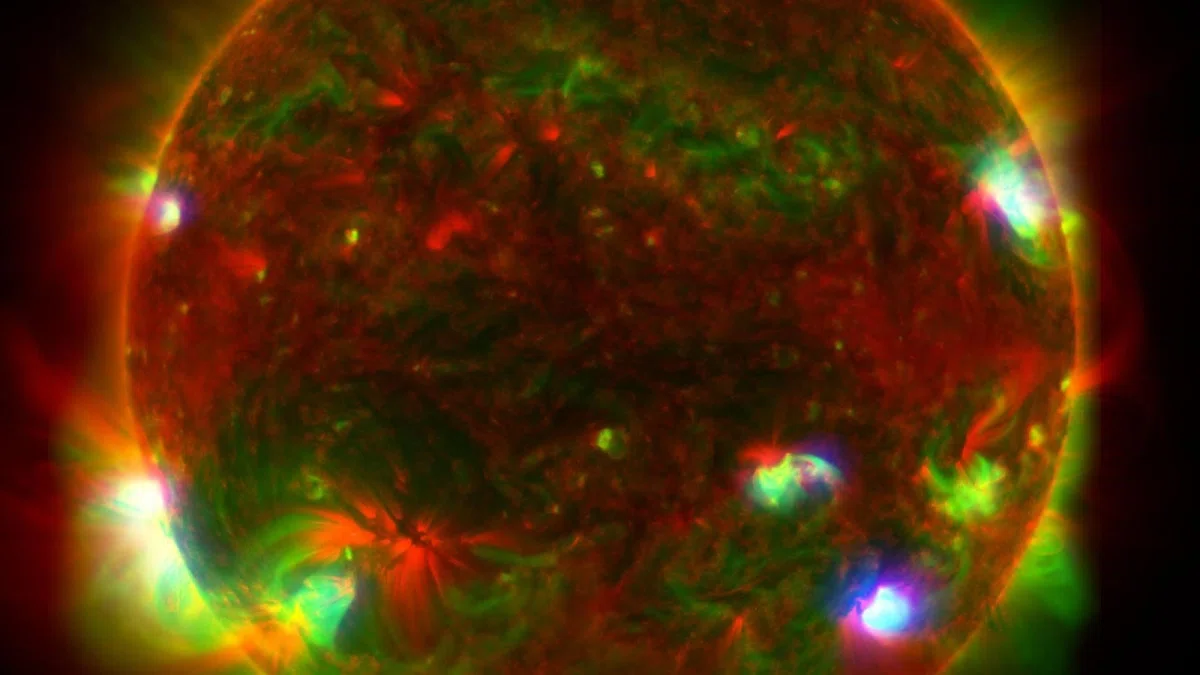
The Sun's own mass ejections during its dying phases will destabilize the orbits of Jupiter, Saturn, Uranus, and Neptune within approximately 1 billion years of white-dwarf formation. This finding, from a study led by Caltech planetary astrophysicist Konstantin Batygin, cuts prior 30-billion-year estimates thirtyfold and an older quintillion-year benchmark by a factor of a billion.
The study, titled "Terminal Instability of the Solar System Triggered by Stochastic Solar Mass Loss," was published in Astrophysical Journal Letters on September 21, 2026. It was co-authored by Jim Fuller of Caltech and Fred C. Adams of the University of Michigan. The research suggests that episodic, asymmetric mass ejections, rather than passing stars or cosmic drift, will drag the outer solar system down.
Previous studies treated the mass-loss process of a red giant as a smooth, continuous flow where orbits expand but remain stable. The new research argues that stars on the red-giant and asymptotic-giant branches produce discrete, asymmetric bursts that deliver jolts to the gravitational field. While individual jolts are small, they are devastating cumulatively due to the chaotic nature of many-body gravitational dynamics.
Batygin's team ran 672 simulations spanning various ejection masses and timing distributions, integrating each for 3 billion years past white-dwarf formation. Approximately 96% of simulated systems matching our own became unstable from these stochastic kicks. Observed white-dwarf velocities from Gaia measurements support this, showing newly formed white dwarfs receive natal recoil velocities of approximately 0.75 km/s.
The simulations revealed three regimes based on the mass carried away per ejection event. Very small kicks produce stable orbits, while intermediate kicks can nudge systems into destabilizing mean-motion resonances. Large kicks, involving ejection masses at or above 10⁻⁵ solar masses, result in instability for the majority of cases.
Observed kick amplitudes and stellar-evolution models suggest the Sun's ejection mass will be near 10⁻⁴ solar masses. This places the solar system in the most destructive category. "What we've shown is that this timeline gets front-run by the Sun's own death," Batygin said.
Key facts
- The Sun's mass ejections could destabilize the outer solar system within 1 billion years of white-dwarf formation.
- Approximately 96% of simulated systems matching our own became unstable due to stochastic kicks.
- The study was published in Astrophysical Journal Letters on September 21, 2026.
Three perspectives
Neutral
The study provides a new timeline for the eventual destabilization of the outer solar system based on asymmetric mass loss.
Positive
The research offers a more precise understanding of the deep future of planetary systems.
Negative
The Sun's own death convulsions are expected to disrupt the orbits of the giant planets.
Your week in news, every Wednesday
The biggest stories of the week for your edition, in your inbox every Wednesday morning, your time. Free, and you can unsubscribe at any time.