

 New Zealand
Ernest Rutherford
Ernest Rutherford was a New Zealand physicist and chemist known as the father of nuclear physics.
 Biography DeskOctober 19, 2026
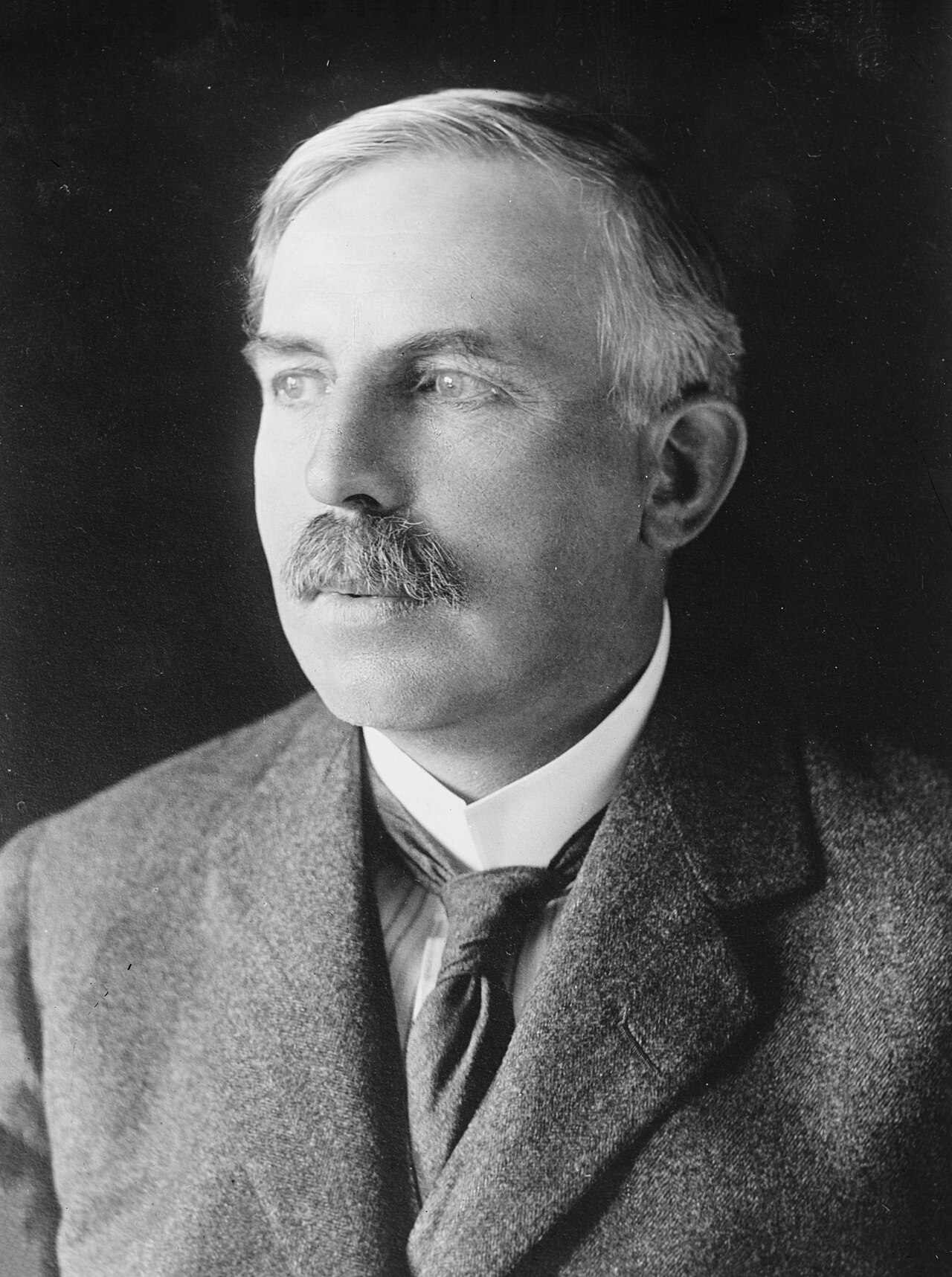
Ernest Rutherford, 1st Baron Rutherford of Nelson, was a New Zealand physicist and chemist. He was a pioneering researcher in atomic and nuclear physics. He received the Nobel Prize in Chemistry in 1908 for his investigations into radioactive substances and the disintegration of elements.
Born on 30 August 1871 in Spring Grove, Nelson Province, he was the fourth of twelve children. His father, James Rutherford, was a mechanic from Perth, Scotland, and his mother, Martha, was a schoolteacher from England. He attended Foxhill School and later Havelock School in the Marlborough Sounds.
Rutherford won a scholarship to Nelson College in 1887 and served as head boy in 1889. In 1889, he won another scholarship to study at Canterbury College, University of New Zealand. He earned degrees in Pure Mathematics and Latin, Mathematics, Mathematical Physics and Physical Science, and Chemistry and Geology between 1892 and 1894.
He moved to England in 1895 to study at the Cavendish Laboratory at the University of Cambridge. While working under J. J. Thomson, he detected radio waves at 0.5 miles in 1896. In 1898, he accepted the Macdonald Chair of Physics at McGill University in Montreal, Canada.
At McGill, Rutherford and Frederick Soddy identified the noble gas thoron and coined the term half-life. They also identified alpha and beta radiation, and Rutherford later named gamma radiation in 1903. In 1907, he returned to Britain for the Langworthy Professorship at the Victoria University of Manchester.
In 1911, Rutherford theorised that atoms have a small, charged nucleus based on the gold foil experiment. He worked with Niels Bohr in 1912 to develop the Bohr model of the atom. In 1917, he performed the first artificially induced nuclear reaction and discovered the proton.
Rutherford became Director of the Cavendish Laboratory in 1919. During his leadership, James Chadwick discovered the neutron in 1932, and Cockcroft and Walton performed the first controlled experiment to split the nucleus. He died on 19 October 1937 and was buried in Westminster Abbey.
The chemical element rutherfordium was named after him in 1997. His portrait has appeared on the New Zealand one hundred-dollar note since 1999. He was named the tenth greatest physicist of all time in 1999.
Key facts
- Ernest Rutherford won the Nobel Prize in Chemistry in 1908.
- He discovered the concept of radioactive half-life and named alpha, beta, and gamma radiation.
- He theorised that atoms have a small, charged nucleus in 1911.
- He discovered the proton through experiments involving nitrogen nuclei and alpha particles.
- His portrait has been on the New Zealand one hundred-dollar note since 1999.