

 Tanzania
George Lilanga
George Lilanga was a Tanzanian painter and sculptor of the Makonde people who became an internationally renowned artist.
 Biography DeskOctober 26, 2026
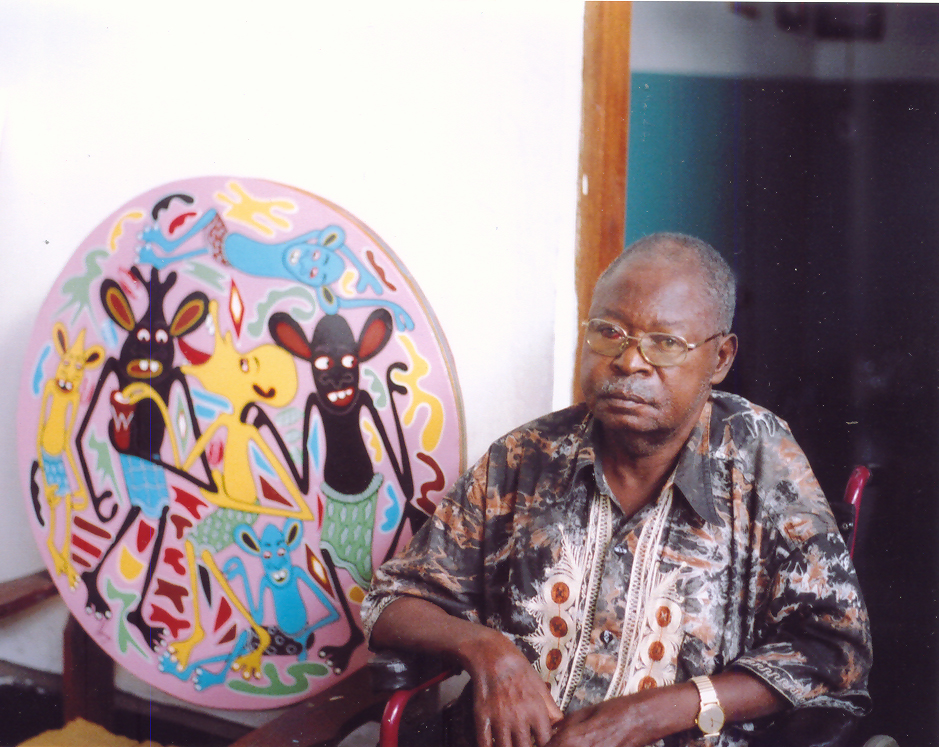
George Lilanga was a Tanzanian painter and sculptor active from the late 1970s until the early 21st century. He belonged to the Makonde people and lived most of his life in Dar es Salaam. His work gained international recognition through exhibitions like Africa Remix 2004 and African Art Now in 2005.
He was born in 1934 in the village of Kikwetu, Masasi district, in the Mtwara Region of southern Tanzania. His father was an agricultural labourer on sisal plantations. Lilanga attended primary school for three years.
In 1970, he moved to Dar es Salaam to find better opportunities for selling sculptures and practicing contemporary art. In 1971, he began working as a night guard at the House of Art, also known as Nyumba ya Sanaa. He later collaborated with the sculptor Augustino Malaba.
Lilanga initially worked in the Makonde tradition carving sculptures from wood. After being exposed to modern artists at Nyumba ya Sanaa, he transformed sculptural forms into paintings, etchings, and panels. He developed a style using Shetani figures that reflected everyday life in Tanzania.
In 1977, he traveled to New York for a show at the Maryknoll Sisters' Ossining Center. In 1978, he participated in a collective exhibition in Washington D.C. where his work was compared to Jean Dubuffet. His art influenced American graffiti artists such as Keith Haring.
During the 1980s, he attended the Salzburg Summer Academy in Austria to learn etching. He also created works on batik cloth, goatskin, and metal sheets. By the 1990s, his paintings became increasingly larger, including oils on canvas and works on Masonite.
In his later years, Lilanga managed an atelier with young pupils and relatives to assist with his work. He continued to produce large canvases and small works on paper and goatskin. He died on 27 June 2005 in his house-atelier at Mbagala in Dar es Salaam.
Key facts
- George Lilanga was a Makonde painter and sculptor born in 1934.
- He transitioned from traditional Makonde wood carving to two-dimensional paintings and etchings.
- His artistic style featured colorful Shetani figures reflecting Tanzanian life.
- He died on 27 June 2005 in Dar es Salaam.