

Euclid telescope finds most distant quasar ever observed
The quasar J1504+6252, nicknamed Dún Aonghasa, was seen 630 million years after the Big Bang.
 Space Desk 2 min read
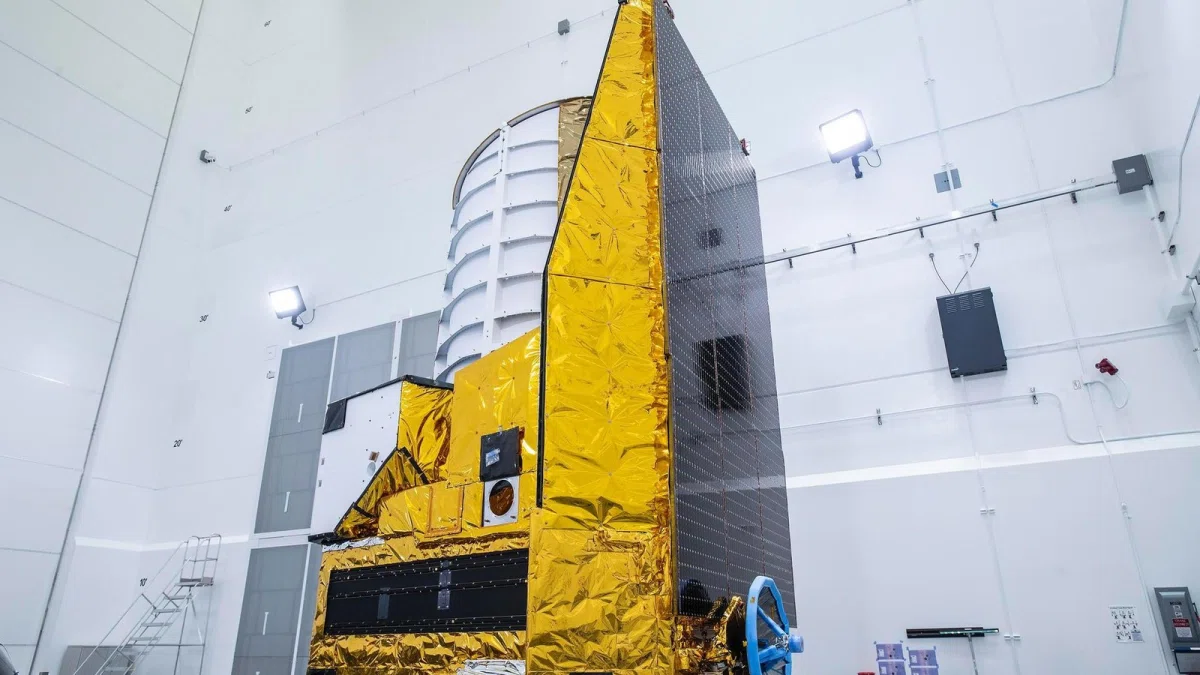
The European Space Agency announced on 24 November 2026 that its Euclid space telescope has discovered the most distant known quasar, J1504+6252. Nicknamed Dún Aonghasa, the object was seen 630 million years after the Big Bang. This discovery extends a record set by Euclid in July by approximately 40 million years.
The quasar is powered by a supermassive black hole with a mass of about 360 million Suns. It sits at a redshift of 8.13, which means the light was observed as the universe was roughly 13.1 billion years ago. At that time, the universe was about 5% of its current age.
Euclid identified the object from survey data collected over 18 months. The finding was confirmed through a follow-up campaign involving the W.M. Keck Observatory, the Large Binocular Telescope Observatory, the Hubble Space Telescope, and the James Webb Space Telescope. Webb's observations specifically confirmed the mass of the central black hole.
The discovery poses a challenge to existing scientific models. Although the black hole is massive, it is consuming material at a relatively slow rate. This suggests the black hole must have grown through extremely rapid episodes very early in cosmic history.
Julien Wolf led the study and is affiliated with the European Southern Observatory. He noted that the leap in cosmic time is huge and that the black hole's size acts as a new deadline for the early universe. The name Dún Aonghasa was chosen to honor a prehistoric stone fort in Ireland.
Key facts
- J1504+6252 is the first quasar identified with a redshift beyond 8.
- The quasar's black hole has a mass of approximately 360 million Suns.
- The object was observed as it existed 630 million years after the Big Bang.
Three perspectives
Neutral
The Euclid telescope identified the quasar J1504+6252 at a redshift of 8.13.
Positive
The discovery provides a new, better-measured anchor point for groups modelling early galaxy and black hole formation.
Negative
The black hole's massive size and slow feeding rate challenge current accounts of how the first supermassive black holes formed.
Your week in news, every Wednesday
The biggest stories of the week for your edition, in your inbox every Wednesday morning, your time. Free, and you can unsubscribe at any time.