

AMD reveals Zen 6 cores with up to 31 percent IPC gains
The new architecture features frequency-optimized Zen 6 and density-optimized Zen 6c variants for AI and server workloads.
 Technology Desk 2 min read
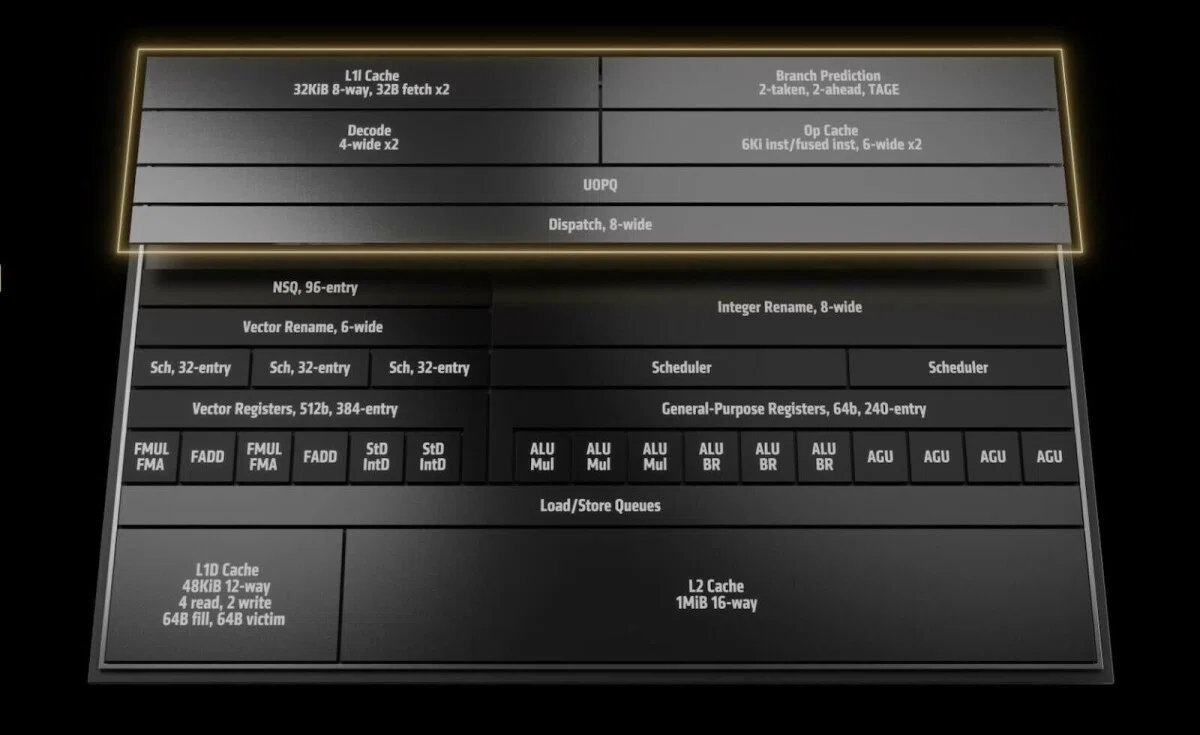
AMD has unveiled its latest Zen cores, which promise an average 27 percent uplift in instructions per clock (IPC) across various AI and server workloads. The chips feature clocks ranging from 4.1 to 5.3 GHz and can boast up to 256 cores. These gains in power, IPC, and clocks suggest the cores represent one of the company's largest generational jumps.
The Zen 6 architecture comes in two versions: a frequency-optimized Zen 6 and a density-optimized Zen 6c. Both versions share the same instruction set architecture (ISA), with clock speed serving as the main differentiator. To account for slower clocks on the Zen 6c, AMD provided the core's scheduler with deeper queues to assist with higher-latency workloads. Conversely, the shallower queue in the Zen 6 enables higher clock speeds on less power.
Micro-architectural changes include a move to a distributed scheduler in the out-of-order pipeline and improvements to the front end. Mike Clark said the Zen 6 team improved the front end for larger footprint workloads that have a bipolar nature. On the backend, AMD implemented changes to support vector heavy workloads, such as AI, by allowing the core to perform four AVX2 or two AVX-512 loads per cycle.
The Zen 6c design follows a philosophy used in previous compact core architectures, where the core is nearly identical to the standard version but trades clocks and cache for density.
Key facts
- Zen 6 cores offer an average 27 percent IPC uplift for AI and server workloads.
- The architecture includes both frequency-optimized Zen 6 and density-optimized Zen 6c variants.
- Zen 6 chips can feature up to 256 cores and clocks up to 5.3 GHz.
Three perspectives
Neutral
AMD introduced its Zen 6 architecture featuring two core variants designed for different workload priorities.
Positive
The new cores promise significant performance jumps through improvements in IPC, clock speeds, and power efficiency.
Negative
PC buyers may not see the same generational gains in gaming as seen in enterprise workloads.
Your week in news, every Wednesday
The biggest stories of the week for your edition, in your inbox every Wednesday morning, your time. Free, and you can unsubscribe at any time.