

 Singapore
Scientists propose method to detect hypothetical mirror life
Researchers suggest using circularly polarized luminescence to identify organisms made from mirror-image molecular building blocks.
 Science Desk 2 min read
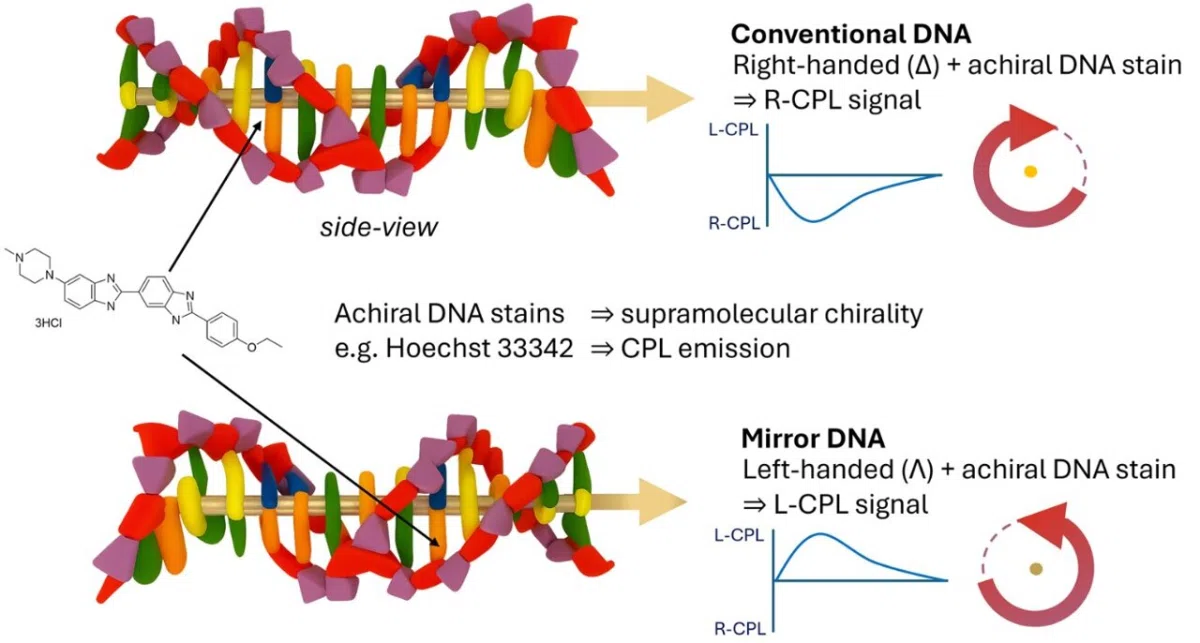
Scientists have proposed what they believe is the first method for detecting mirror life, a hypothetical form of life made from molecular building blocks that are the mirror image of those found naturally on Earth. Researchers at the University of Strathclyde and the Department of Chemistry at Durham University outlined an approach that could identify mirror organisms using molecules that emit left- and right-handed light.
The proposed method uses circularly polarized luminescence (CPL), a property of light that can reveal information about the chirality, or handedness, of molecules and biological structures. The researchers suggest using fluorescent probes that bind to structures within cells to produce distinctive CPL signals. These signals could provide a molecular fingerprint to indicate whether a biological sample has conventional terrestrial chirality or its mirror image.
To minimize false results, the researchers propose using a panel of different probes targeting several biological structures rather than a single measurement. The approach could be tested and developed using conventional biological samples without creating mirror organisms. The team suggests the technique could eventually be used with a wide range of devices.
Mirror life is considered a low-likelihood but potentially high-severity biosecurity threat. There are international concerns that artificially created mirror organisms could interact with the natural world in unpredictable ways and potentially evade biological defenses protecting humans, animals, and plants. Scientists have called for restrictions on research aimed at creating self-replicating mirror organisms.
The researchers stress that mirror life does not currently exist and their proposed method is intended as a contingency measure. Existing CPL detection technologies, such as microscopes, cameras, and biological cell plate readers, have already been demonstrated at laboratory scale by Professor Robert Pal. However, a complete mirror-life detection assay has not yet been experimentally demonstrated.
Key facts
- Researchers at the University of Strathclyde and Durham University proposed a method to detect mirror life using circularly polarized luminescence.
- Mirror life is a hypothetical form of life made from molecular building blocks that are mirror images of those found on Earth.
- The proposed detection method uses fluorescent probes to create a molecular fingerprint of a sample's chirality.
Three perspectives
Neutral
Researchers have proposed a contingency method to detect hypothetical mirror organisms using circularly polarized luminescence.
Positive
The proposed approach could be tested and developed using conventional biological samples without the need to create mirror organisms.
Negative
Artificially created mirror organisms could interact with the natural world in unpredictable ways and potentially evade biological defenses.
Your week in news, every Wednesday
The biggest stories of the week for your edition, in your inbox every Wednesday morning, your time. Free, and you can unsubscribe at any time.