 South Africa
Researchers develop lunar insulation from moon dust and waste
Purdue University scientists are creating ultralight aerogels using cellulose and lunar regolith simulant to protect habitats from extreme temperature swings.
 Space Desk 2 min read
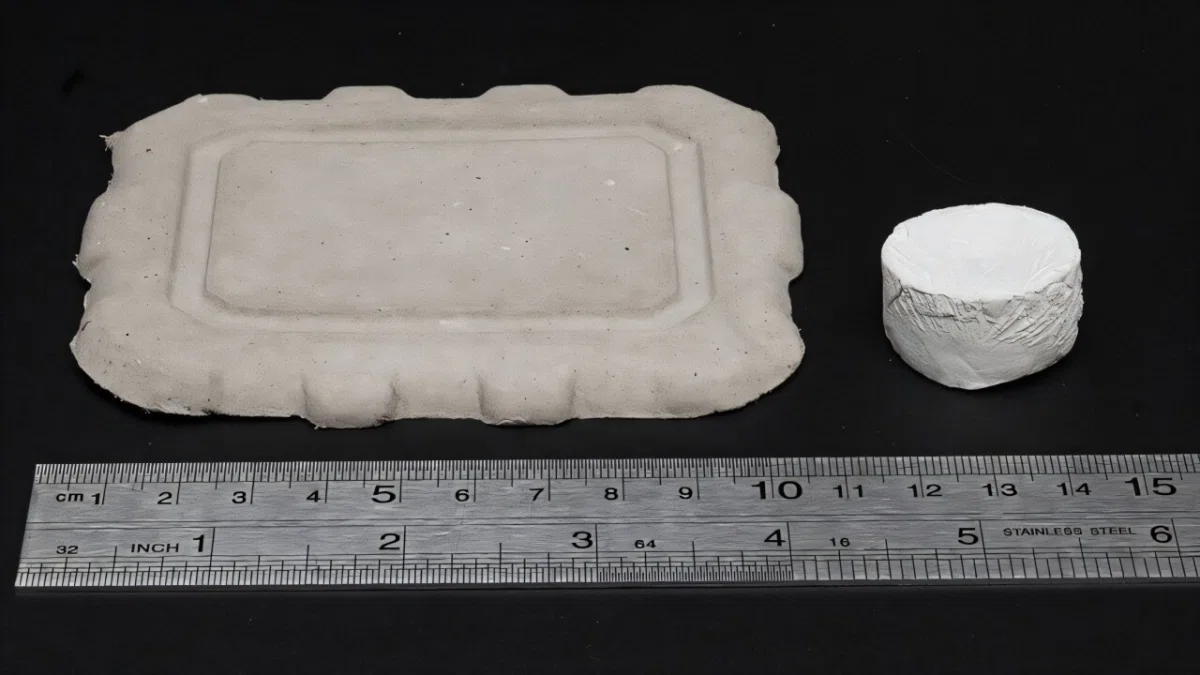
Researchers at Purdue University's College of Science are developing methods to create aerogels, which are ultralight insulating materials, using components that could be generated on the moon. These aerogels are made of cellulose and lunar regolith simulant that are ground together and mixed into a slurry before being frozen and dried.
The project aims to use in situ resource utilization to address the extreme temperatures on the moon, which can reach 127 degrees Celsius during the day and drop to minus 173 degrees Celsius at night. Alexander Wei and Jacob Staker are using cellulose, a natural fiber that can be derived from paper or cardboard waste, and lunar regolith simulant, a material similar to moon dust.
The regolith used contains mostly orthosilicates and aluminosilicates, which are minerals in the moon's crust. During the process, the regolith, cellulose fibers, and water are ground in a planetary ball mill. The minerals help break the cellulose into nanofibrillated cellulose, which are ultrafine strands with diameters below 1 micron.
These nanofibrillated fibers increase the surface area and mechanical integrity of the aerogel, allowing it to deflect heat without crumbling. Once the mixture is a slurry, it is frozen and turned into an aerogel. While supercritical drying is a common industrial method, Wei and Staker are studying lyophilization, or freeze-drying, because it is more practical for the moon.
Freeze-drying is more sustainable for lunar production because the equipment is simpler and the lunar surface provides a natural vacuum and subfreezing temperatures at night. The water removed during the sublimation process can be recovered and reused in a circular manufacturing process.
Key facts
- Alexander Wei and Jacob Staker are developing aerogels made from cellulose and lunar regolith simulant.
- The aerogels use nanofibrillated cellulose to increase mechanical integrity and thermal deflection.
- Freeze-drying is being studied as a more practical production method for the moon than supercritical drying.
Three perspectives
Neutral
Researchers are developing aerogel insulation for lunar habitats using local materials and waste products.
Positive
The proposed freeze-drying method allows for a circular manufacturing process where water can be recovered and reused.
Negative
Standard industrial aerogel production via supercritical drying is energy-intensive and requires carbon dioxide, which is not readily available on the moon.
Your week in news, every Wednesday
The biggest stories of the week for your edition, in your inbox every Wednesday morning, your time. Free, and you can unsubscribe at any time.