

Massive glass sponge colony discovered in Pacific Ocean
The sponge colony, measuring approximately the size of a minivan, was found at a depth of 2,130 meters during a NOAA expedition.
 Science Desk 2 min read
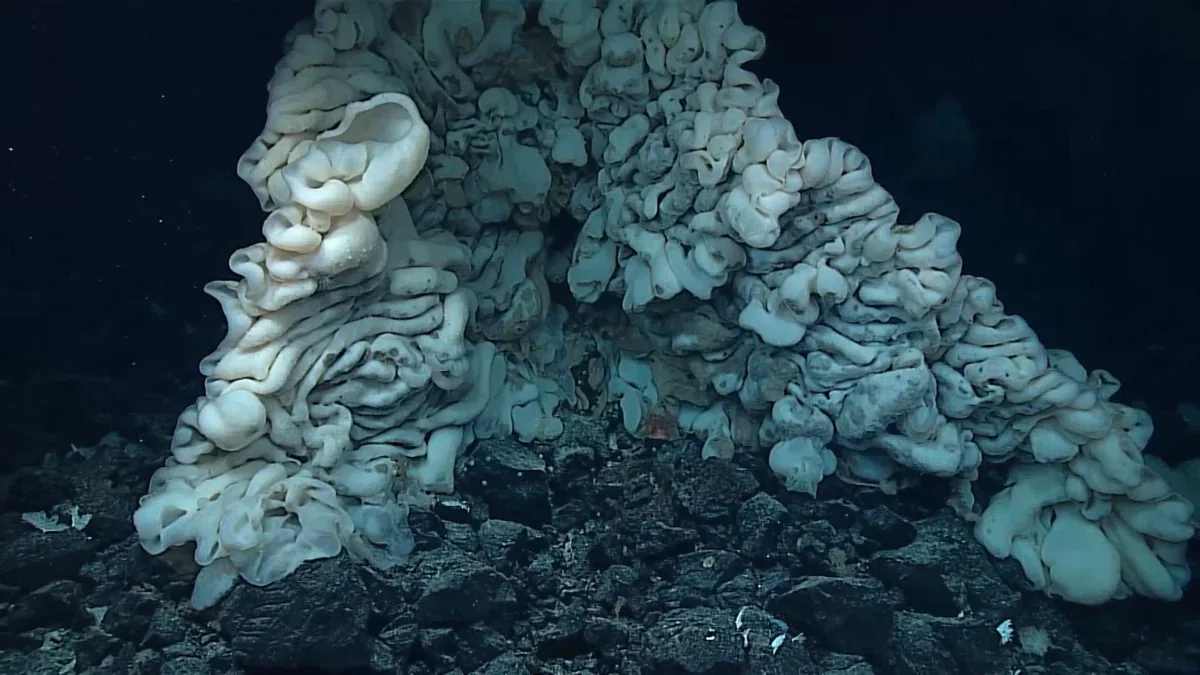
NOAA scientists discovered a massive glass sponge colony at a depth of 2,130 meters in the Papahānaumokuākea Marine National Monument. The colony measured 3.7 meters long, 2.1 meters wide, and 1.5 meters high, which is about the size of a minivan.
Researchers spotted the animal on a ridge using a remotely operated vehicle called Deep Discoverer during the 2015 Hohonu Moana: Exploring Deepwaters off Hawaiʻi expedition. Two parallel laser beams projected onto the sponge allowed the team to measure its height and width, while a second vehicle, Seirios, captured images from above to help determine its length.
The dimensions of this colony exceeded the previous record held by a colony of the glass sponge Aphrocallistes vastus, which measured 3.4 meters long, 0.5 meters wide, and 1.1 meters high in shallow waters off western Canada.
While the exact species of the new discovery remains unidentified, examining microscopic skeletal structures called spicules from a nearby specimen revealed it belongs to the glass sponge family Rossellidae. These sponges have skeletons made of silica and act as filter feeders, drawing seawater through their bodies to extract food.
The exact age of the sponge is unknown, though a 2008 study suggested some giant barrel sponges could live for more than 2,300 years. NOAA marine biologist Daniel Wagner said in 2016 that finding such an enormous and presumably old sponge emphasizes how much can be learned from studying remote, pristine environments.
Key facts
- The sponge colony measured 3.7 meters long, 2.1 meters wide, and 1.5 meters high.
- The discovery occurred at a depth of 2,130 meters during a 2015 NOAA expedition.
- The sponge belongs to the Rossellidae family of glass sponges.
Three perspectives
Neutral
The enormous glass sponge colony was discovered at a depth of 2,130 meters in the Papahānaumokuākea Marine National Monument.
Positive
Finding such an enormous and presumably old sponge emphasizes how much can be learned from studying deep and pristine environments.
Negative
The exact species of the record-holding sponge remains unidentified.
Your week in news, every Wednesday
The biggest stories of the week for your edition, in your inbox every Wednesday morning, your time. Free, and you can unsubscribe at any time.