

Curiosity rover targets Nazca site for new Mars drilling campaign
NASA's Curiosity rover has identified a promising target filled with disc- and needle-shaped crystal forms for its next drilling operation.
 Space Desk 2 min read
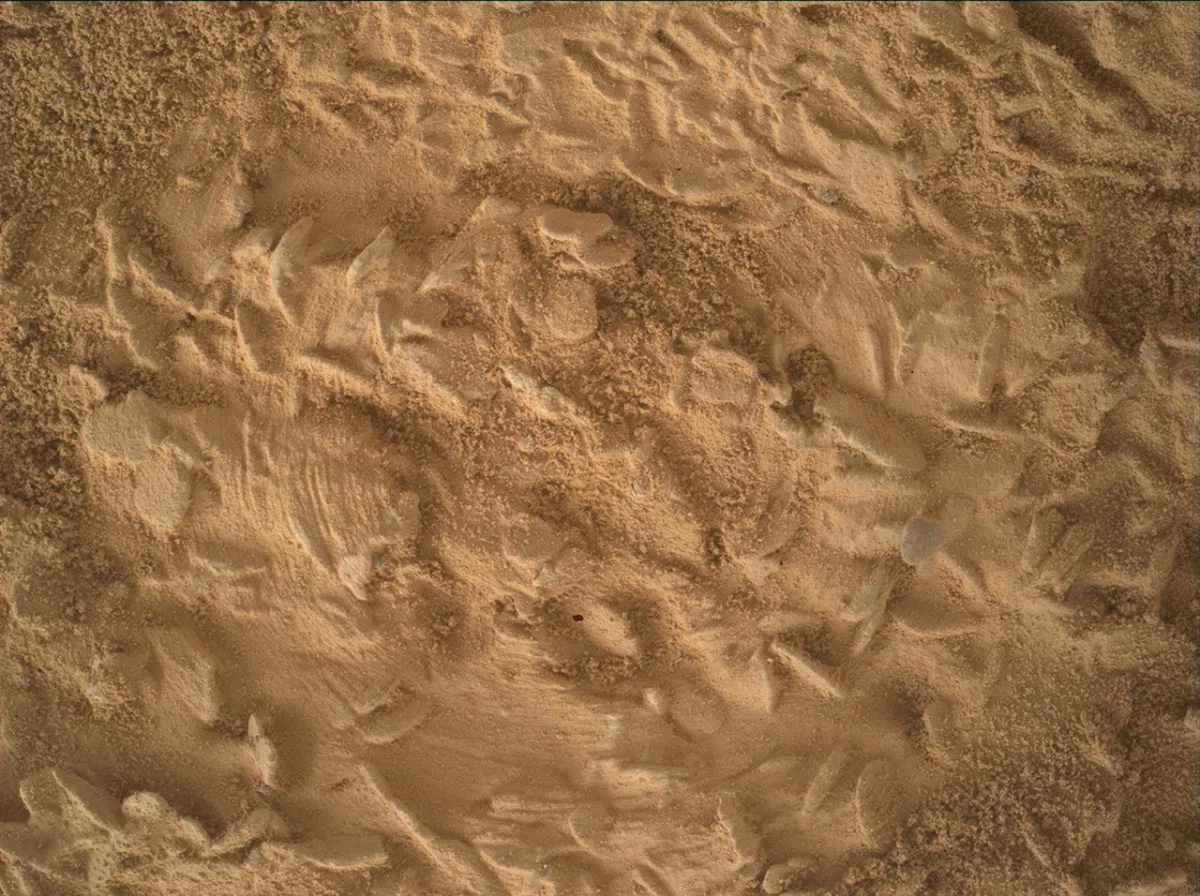
NASA's Mars rover Curiosity has moved to a new site informally named Nazca to begin a drilling campaign. The rover returned to a spot a few meters away from the Chiu Chiu block following the Basque Lakes drill campaign. The team gave the science go-ahead to prepare for drilling at Nazca after imaging showed the block was jam-packed with disc- and needle-shaped lumps.
Scientists hypothesize that these textures were originally created during the growth of crystal forms. The relatively large sizes of the crystal forms at Nazca and Chiu Chiu may provide clues about the temperature and the availability of salts and fluids when they grew. However, the team noted that modern-day composition might not represent the original mineral if crystals were replaced by other minerals to become pseudomorphs.
The rover will use its Mars Hand Lens Imager (MAHLI) to conduct a Quantitative Relief Model observation using five overlapping images to construct a three-dimensional relief model. MAHLI will also add extra frames to its highest-resolution imaging by doubling the number of focus mechanism steps.
The ChemCam LIBS instrument will perform a depth profile experiment on a nearby target named Toucan. Instead of the usual five-point raster, the team will concentrate all 150 laser shots on the same spot to penetrate approximately five times deeper than a normal observation. This will allow scientists to see if the composition deeper inside the crystal form differs from the surface level.
Before the drill preload test, the LIBS, DRT, and APXS instruments will characterize the surface composition of the Nazca spot. Additionally, the LIBS will target a nearby block called Condor, which has an exposed finely layered texture.
Key facts
- Curiosity acquired a close-up image of the Nazca site on Oct. 18, 2026.
- The Nazca site contains abundant disc-shaped potential crystal forms.
- The ChemCam LIBS will use 150 laser shots on a single spot at the Toucan target to obtain deeper compositional information.
Three perspectives
Neutral
Curiosity is preparing to drill at the Nazca site to study disc- and needle-shaped crystal forms.
Positive
The team identified a promising new drilling target that is jam-packed with interesting crystal-shaped lumps.
Negative
Modern-day mineral composition may not represent the original minerals if they have been replaced by pseudomorphs.
Your week in news, every Wednesday
The biggest stories of the week for your edition, in your inbox every Wednesday morning, your time. Free, and you can unsubscribe at any time.