Lab experiment demonstrates heating mechanism for the sun's corona
Researchers recreated corona-like conditions using a laser facility to show how plasma instabilities drive nanoflares.
 Space Desk 2 min read
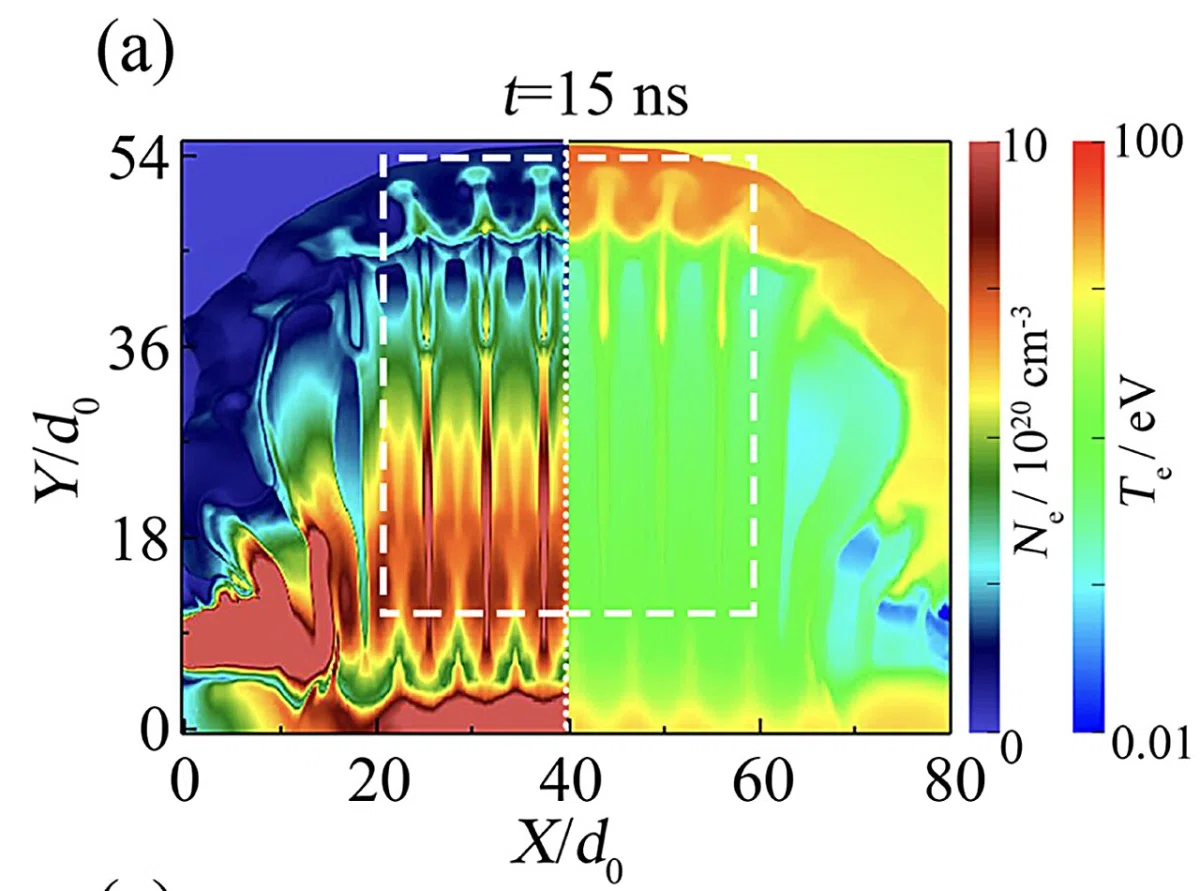
A team led by Wei Sun at the China Institute of Atomic Energy has recreated corona-like conditions in a laboratory. The experiment provides the first-ever lab demonstration of nanoflare heating driven by plasma instabilities.
Using China's Shenguang-II laser facility, the researchers fired powerful laser beams at tiny plastic targets with wavy surfaces. This produced a plasma just millimeters across with instabilities seeded in a precisely controlled way. The plasma was tuned to behave similarly to the plasma around coronal rain.
The team reproduced finger-like structures seen in the real corona, which pushed oppositely directed magnetic fields together and drove reconnection. This process allowed electrons to reach around 820,000 K, which is about twice the maximum temperature produced by flat targets used for comparison.
Computer simulations showed that electrical heating within the reconnecting current layers far outweighed heating through friction within the plasma. When simulations suppressed the generation of magnetic fields, most of the extra heating vanished, strengthening the magnetic explanation.
The sun's surface radiates heat at 5,800 Kelvin, yet electrons in the corona can reach temperatures of millions of degrees. The leading explanation is that churning plasma twists and stretches magnetic fields, which eventually break and rejoin in a process called reconnection to release energy.
Sun's team now hopes to build on the experiment with more 3D plasmas and more precise measurements. This could help researchers determine if nanoflares occur often enough to explain a large fraction of the corona's heat.
Key facts
- Wei Sun led a team that recreated corona-like conditions in a lab using the Shenguang-II laser facility.
- The experiment demonstrated that plasma instabilities can drive nanoflare heating through magnetic reconnection.
- Electrons in the experiment reached approximately 820,000 K.
Three perspectives
Neutral
Researchers used laser-produced plasma to study how magnetic reconnection might heat the sun's corona.
Positive
The results could fill an important gap in the understanding of how the corona is heated.
Negative
Astronomers have yet to fully explain why electrons in the sun's corona reach millions of degrees.
Your week in news, every Wednesday
The biggest stories of the week for your edition, in your inbox every Wednesday morning, your time. Free, and you can unsubscribe at any time.