

Space agencies release spooky cosmic images for Halloween
Images of colliding galaxies, a pulsar wind nebula, and the Sun reveal the scientific reality behind hauntingly familiar shapes in the Universe.
 Space Desk 2 min read
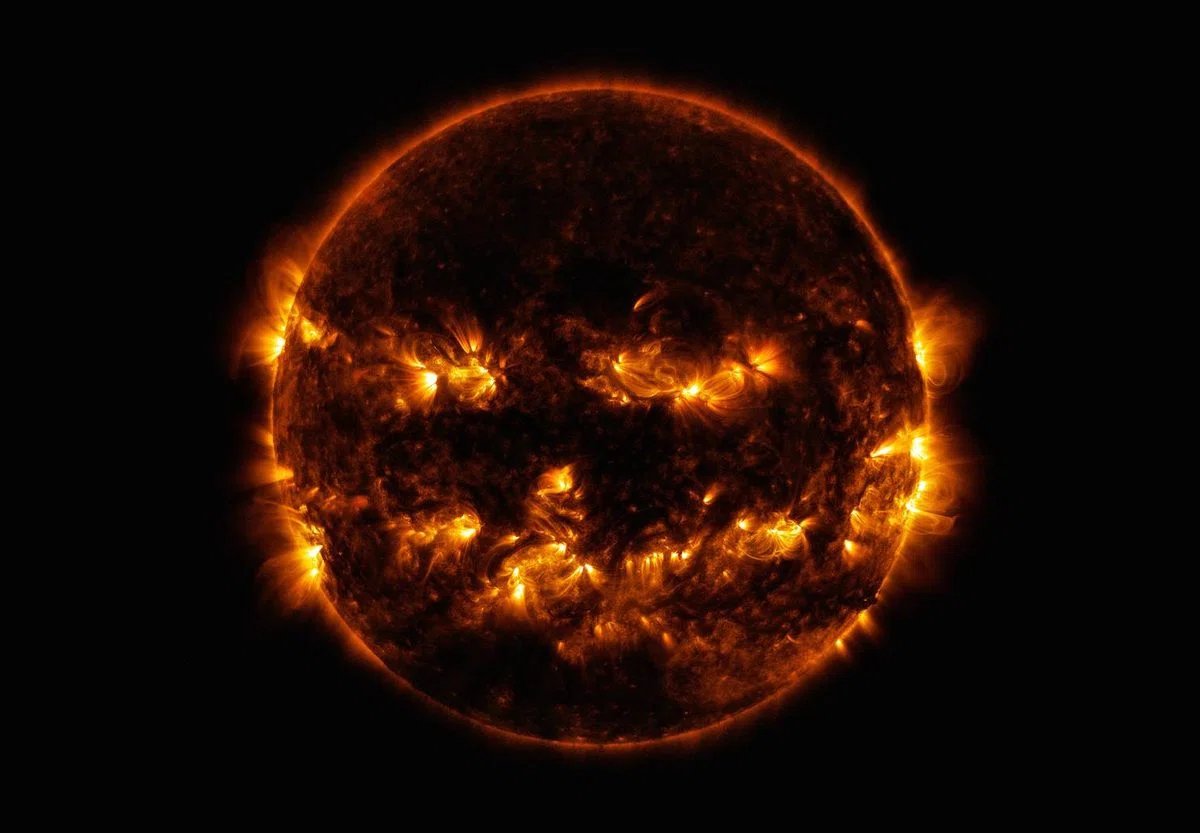
Space agencies have released images of objects in space that resemble spooky shapes for Halloween. These views include ghostly galaxy collisions, pumpkin-shaped cosmic clouds, and glowing stellar eyes.
NASA’s Solar Dynamics Observatory (SDO) captured an image of the Sun that resembles a jack-o'-lantern face. The resemblance comes from active regions in the corona, which are intense magnetic fields that appear bright because they emit high levels of light and energy. The image blends two extreme ultraviolet wavelengths, 171 and 193 ångströms, typically rendered in gold and yellow.
Three observatories, including NASA's Chandra X-ray Observatory, captured a ghostly hand-like feature known as the pulsar wind nebula MSH 15-52. This nebula surrounds the spinning neutron star, pulsar PSR B1509-58. Data from the Imaging X-ray Polarimetry Explorer (IXPE) allowed astronomers to map the nebula's magnetic field for the first time by tracking X-ray electric field orientations.
The Hubble Space Telescope captured images of colliding galaxies in the constellation Canis Major that resemble a jack-o’-lantern. The two glowing eyes are galaxies NGC 2292 and NGC 2293, which are in the early stages of merging. A separate Hubble observation of the interacting system Arp-Madore 2026-424 shows a ghostly face with bright central cores acting as eyes and a ring of hot newborn stars forming the face outline.
Other observations include CW Leonis, a red giant star 400 lightyears away in the constellation Leo that is shedding its outer layers into space. The Spitzer Space Telescope also captured a feature resembling a carved Halloween pumpkin by combining three distinct wavelengths of infrared light.
Key facts
- The 'NASA Halloween Sun' image shows active magnetic fields in the solar corona.
- The pulsar wind nebula MSH 15-52 surrounds the neutron star PSR B1509-58.
- Galaxies NGC 2292 and NGC 2293 are merging in the constellation Canis Major.
Three perspectives
Neutral
Space agencies release images of cosmic phenomena that resemble spooky shapes.
Positive
Astronomers used IXPE data to map the magnetic field of a pulsar wind nebula for the first time.
Negative
A galactic collision involves immense gravitational forces that churn up interstellar gas and dust.
Your week in news, every Wednesday
The biggest stories of the week for your edition, in your inbox every Wednesday morning, your time. Free, and you can unsubscribe at any time.