New SGH building reduces acute stroke treatment time to 82 minutes
 Health Desk 2 min read
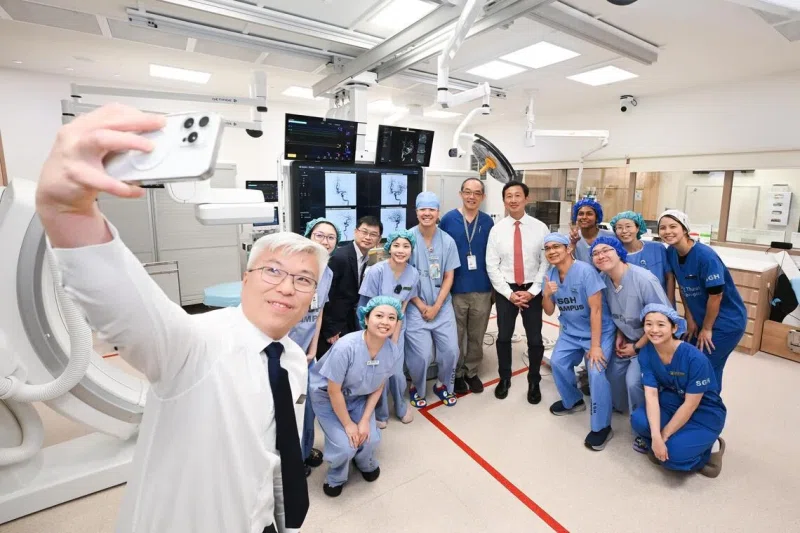
Patients experiencing an acute stroke can be assessed, scanned and treated in as little as 82 minutes, down from 130 minutes, at the newly opened Singapore General Hospital (SGH) Emergency and National Neuroscience Institute (NNI) building.
The 12-storey, 14,000 sq m facility is six times larger than its previous space in Block 1. It features 10 triage rooms, 53 critical care cubicles, 12 resuscitation rooms, and over 150 short-stay beds.
Minister for Health Ong Ye Kung officially opened the building on Oct 30. He said the co-location with NNI is designed to provide a faster response to stroke patients, as a blocked blood vessel needs to be cleared within the golden hour. Ong noted that AI now cuts scan time to six minutes.
The facility includes Singapore’s first emergency department-based angiography suite, which allows patients to undergo endovascular thrombectomy to reopen blocked blood vessels in the brain within minutes of diagnosis. This eliminates the need to transfer patients to the SGH main blocks, which can cause severe hospital transit delays.
One of the two critical care areas, containing 29 cubicles, can be converted into a negative pressure area during a pandemic, according to Ivan Chua, head and senior consultant of SGH’s Department of Emergency Medicine.
The NNI portion of the building houses a larger neuroscience clinic where therapists can work alongside neurologists and nurses. This allows care team discussions to happen quickly and enables patients to see different therapists during a single visit.
Key facts
- Acute stroke treatment time has been reduced from 130 minutes to 82 minutes.
- The new 12-storey facility is 14,000 sq m and six times larger than the previous space.
- The building includes the first emergency department-based angiography suite in Singapore.
Three perspectives
Neutral
The new SGH Emergency and NNI building co-locates emergency assessment, acute medical care, and advanced neuroscience intervention under one roof.
Positive
The facility speeds up life-saving endovascular thrombectomy by allowing patients to be treated without being transferred to main hospital blocks.
Negative
Longer transit times for stroke patients increase the risk of permanent brain damage, severe disability, and poorer long-term survival rates.
Your week in news, every Wednesday
The biggest stories of the week for your edition, in your inbox every Wednesday morning, your time. Free, and you can unsubscribe at any time.