

Stupendously large primordial black holes cannot make up meaningful dark matter
Even if stupendously large primordial black holes exist, they cannot make up any meaningful fraction of dark matter.
 Space Desk 2 min read
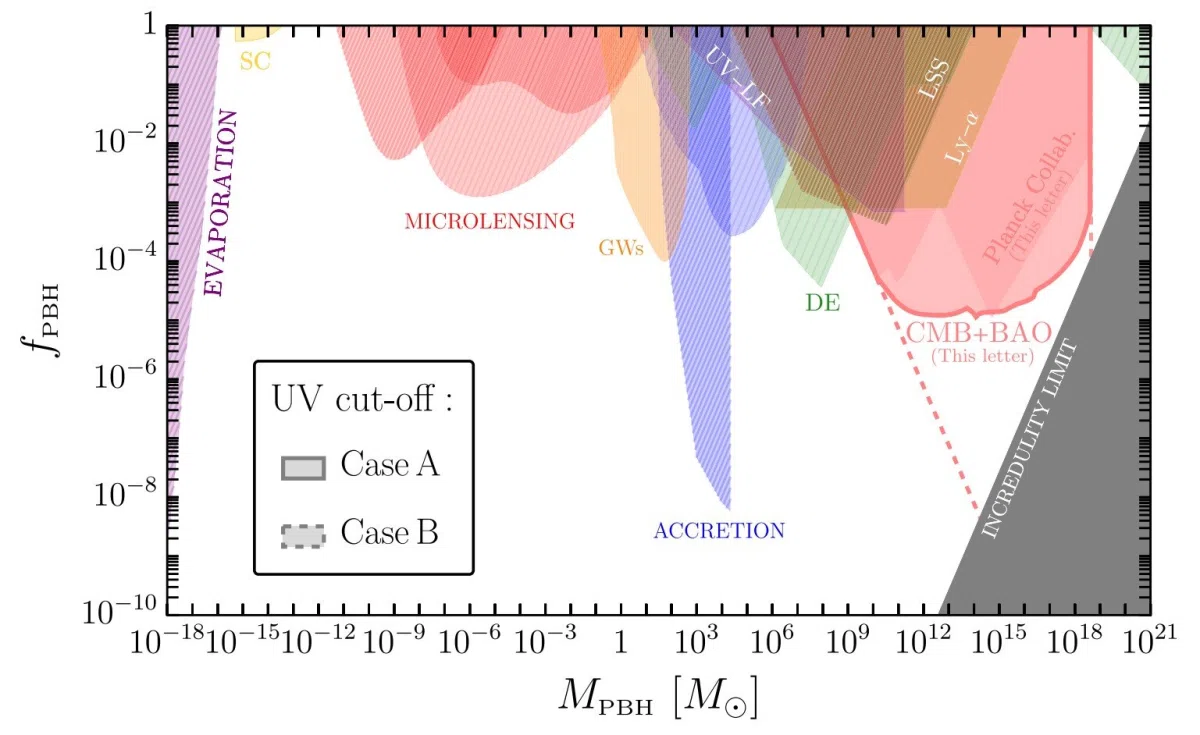
Even if stupendously large primordial black holes exist, they cannot make up any meaningful fraction of dark matter. These hypothetical objects could have formed directly from dense clumps of matter in the very early universe. Their origins would differ from the black holes seen today, which form when massive stars collapse.
Nicholas Leister at the Mainz Institute for Theoretical Physics and colleagues conducted the research, which has been published in Physical Review Letters. The team tested the possibility of a population of primordial black holes, each weighing at least 100 billion times as much as the sun, acting as a dark matter candidate.
If these black holes were scattered randomly through space, the expansion of the universe would cause a breakdown in the balance between dark matter and radiation, resulting in patchy variations. The researchers compared their predictions of these variations with measurements of the cosmic microwave background, the faint afterglow of the Big Bang.
The analysis found that a substantial population of these black holes would leave the balance between dark matter and radiation far too uneven, creating patterns that are not present in the signal. This result also challenges suggestions that primordial black holes helped seed the massive early galaxies spotted by the James Webb Space Telescope.
The study does not rule out primordial black holes in this mass range altogether, as the team assumed all black holes share the same mass. Populations with a wide range of masses still need to be explored before these calculations can be fully conclusive.
Researchers predict that upcoming CMB experiments, including LiteBIRD and the Simons Observatory, will tighten these limits even further. They also hope to extend their analysis to even heavier black holes by searching for the gravitational waves that would have been released as they formed.
Key facts
- Stupendously large primordial black holes cannot make up a meaningful fraction of dark matter.
- The research was published in Physical Review Letters.
- The findings challenge suggestions that primordial black holes helped seed massive early galaxies spotted by the James Webb Space Telescope.
Three perspectives
Neutral
The study places tight new limits on how much stupendously large primordial black holes could contribute to dark matter.
Positive
Upcoming CMB experiments, including LiteBIRD and the Simons Observatory, are expected to tighten these limits further.
Negative
The results challenge suggestions that primordial black holes helped seed the massive early galaxies spotted by the James Webb Space Telescope.
Your week in news, every Wednesday
The biggest stories of the week for your edition, in your inbox every Wednesday morning, your time. Free, and you can unsubscribe at any time.