

 Sri Lanka
John Kotelawala
General Sir John Lionel Kotelawala was the third Prime Minister of Ceylon, serving from 1953 to 1956.
 Biography DeskOctober 26, 2026
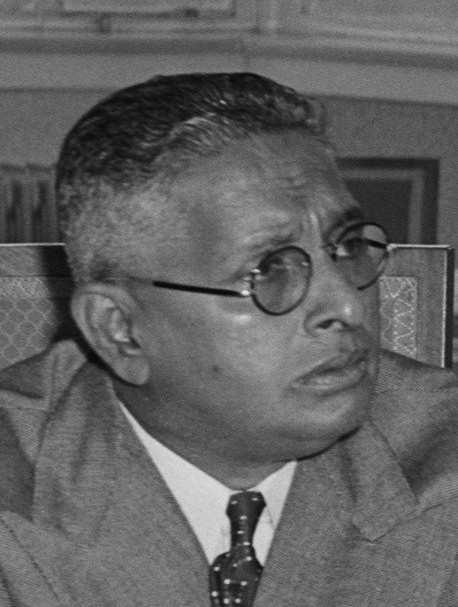
General Sir John Lionel Kotelawala was a Sri Lankan statesman and a longtime member of the United National Party. He served as the third Prime Minister of Ceylon from 1953 to 1956. He also held various cabinet positions under previous governments.
Born on 4 April 1897 to John Kotelawala Snr and Alice Elisabeth Kotelawala, he came from a wealthy landholding and mining family. His childhood was difficult following the suicide of his father. He was educated at Royal College, Colombo, and Christ's College, Cambridge.
Kotelawala became a planter to run family estates and mines after returning to Ceylon. He joined the Ceylon Defense Force as a volunteer officer in 1922 and rose to the rank of colonel in 1942. He served as the commanding officer of the Ceylon Light Infantry.
He entered mainstream politics in 1931 when he was elected to the State Council of Ceylon. He later served as Minister of Communications and Works in the Second Board of Ministers. Following independence in 1948, he was elected to Parliament and became Minister of Transport and Works.
After the death of D. S. Senanayake, Kotelawala succeeded Dudley Senanayake as Prime Minister in 1953. His administration oversaw economic recovery and a substantial trade surplus. He also promoted a "house-owning democracy" through a national housing framework.
As Prime Minister, he played a role in foreign policy by convening the 1954 Colombo Conference. He advocated an anti-colonialism that opposed Soviet expansionism and international communism. Domestically, he pursued a strongly anti-communist policy to restrict the influence of communist organisations.
Kotelawala retired from politics in 1956 and went to self-imposed exile in Kent. He donated his home, Kandawala, to the state to form a defense university. He was awarded the rank of general on his deathbed and died on 2 October 1980.
Key facts
- He served as the third Prime Minister of Ceylon from 1953 to 1956.
- He convened the Colombo Conference in 1954 to help lay the groundwork for the Asian-African Conference.
- His administration established a national housing framework and the Department of National Housing in 1953.
- He was a member of the United National Party and served as Minister of Transport and Works.