

 New Zealand
Euclid telescope data reveals 15,000 strong gravitational lenses
The first major data release from the Euclid mission includes 10,000 sharp images and 160 million spectra to study dark matter and dark energy.
 Space Desk 2 min read
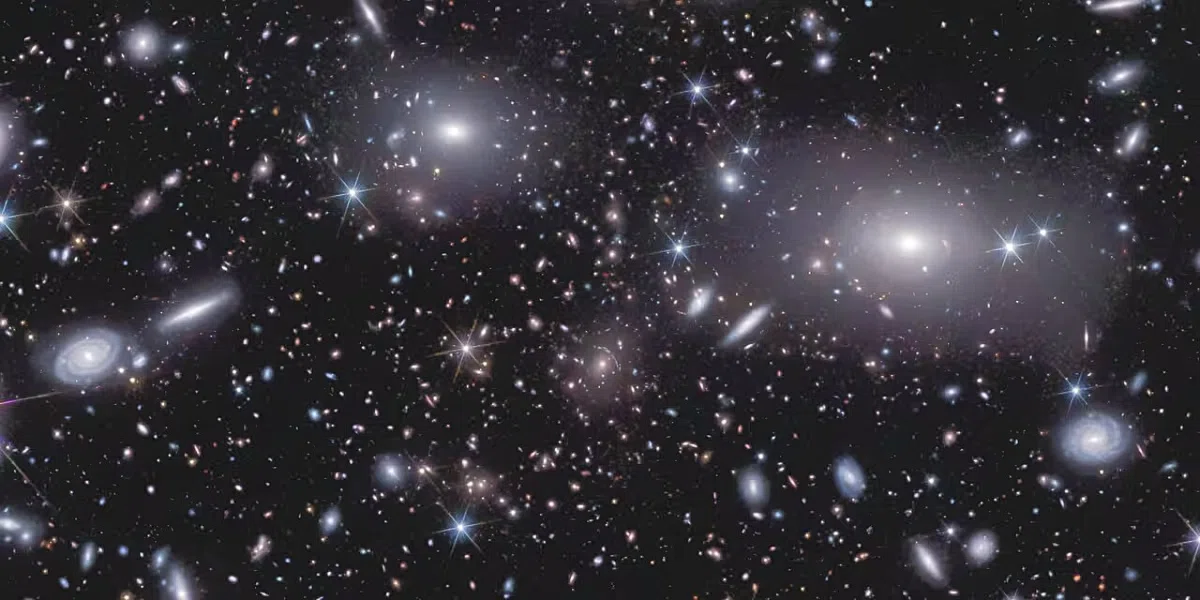
The Euclid space telescope has released its first major set of data, covering approximately 1,900 square degrees of the sky. This release represents about 14% of the area planned for the six-year mission and 5% of the total sky. The dataset includes roughly 10,000 sharp images from the VIS and NISP instruments, alongside more than 160 million spectra.
Researchers used machine learning models to classify 68 million images, identifying 15,000 high-quality strong gravitational lenses. Gravitational lensing occurs when massive objects like galaxy clusters curve spacetime, bending light from distant objects into shapes such as rings or arcs. The machine learning models performed with higher accuracy because they were trained using a preview of Euclid data from March 2025.
Dr Louis Gabarra from Oxford's Department of Physics led a study using NISP data to map how and where stars form within galaxies. By measuring how the H-alpha emission line from hydrogen shifts toward longer wavelengths as the universe expands, the team could determine galaxy distances and star formation locations. Gabarra said the process effectively turned the spectrometer into an imager by recovering spatial information.
The mission aims to investigate dark matter and dark energy, which are thought to comprise 25% and 70% of the universe respectively. Studying strong gravitational lensing may help scientists rule out different theories regarding the nature of dark matter by observing how it clumps.
Associate Professor Aprajita Verma and her group were part of the international team mining the data for rare lenses. Verma noted that citizen scientists from the Space Warps project helped deliver the largest set of strong lenses known to date. The team expects to discover approximately 170,000 strong lenses by the end of the mission.
Key facts
- Euclid's first major data release covers 1,900 square degrees of the sky.
- The latest data tranche revealed 15,000 high-quality strong gravitational lenses.
- The dataset contains approximately 10,000 sharp images and over 160 million spectra.
Perspectives
Neutral
The Euclid mission has released its first major data set covering 14% of its planned sky area to study dark matter and dark energy.
Positive
The discovery of 15,000 strong gravitational lenses provides an unprecedented wealth of data for the international astrophysics community.
Your week in news, every Wednesday
The biggest stories of the week for your edition, in your inbox every Wednesday morning, your time. Free, and you can unsubscribe at any time.