Canada
Space
Amateur astronomers join NASA's Kilonova Catcher network to track cosmic flashes
The volunteer network helps follow fading light from gravitational-wave alerts and is preparing for alerts from the Nancy Grace Roman Space Telescope.
 Space
The volunteer network helps follow fading light from gravitational-wave alerts and is preparing for alerts from the Nancy Grace Roman Space Telescope.
The quasar J1504+6252, nicknamed Dún Aonghasa, was seen 630 million years after the Big Bang.
 China
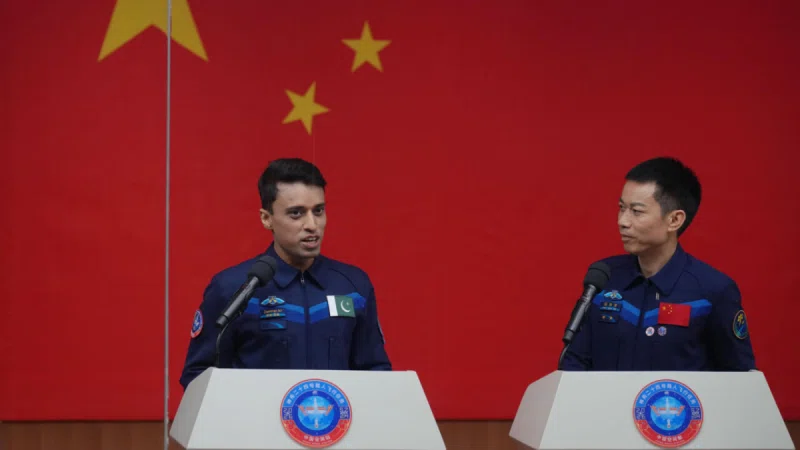
Muhammad Zeeshan Ali will join the Shenzhou-24 mission launching Wednesday from the Gobi Desert.
The spacecraft overcame a last-minute glitch to become only the second craft to orbit the planet closest to the sun.
Dust in the supernova remnant suggests the star's interior changed, possibly just hours before it died.
The mission has arrived at the Didymos binary system to study the aftermath of NASA's DART collision.
The November full Moon marks the beginning of a sequence of four consecutive supermoons ending in February 2027.
New research shows how a spherical black hole and a surrounding ring-shaped black hole can rotate independently in two planes.
The American astronaut, who travelled around the Moon in April on Artemis II, received the main award at the 12th Explorers Festival.
The smallest planet in the solar system is well placed for observation following its greatest western elongation.