ESA Euclid mission releases data covering 9,500 full moons
The DR1-Foundation data release captures light from more than 1 billion objects to help scientists study dark energy and dark matter.
 Space Desk 2 min read
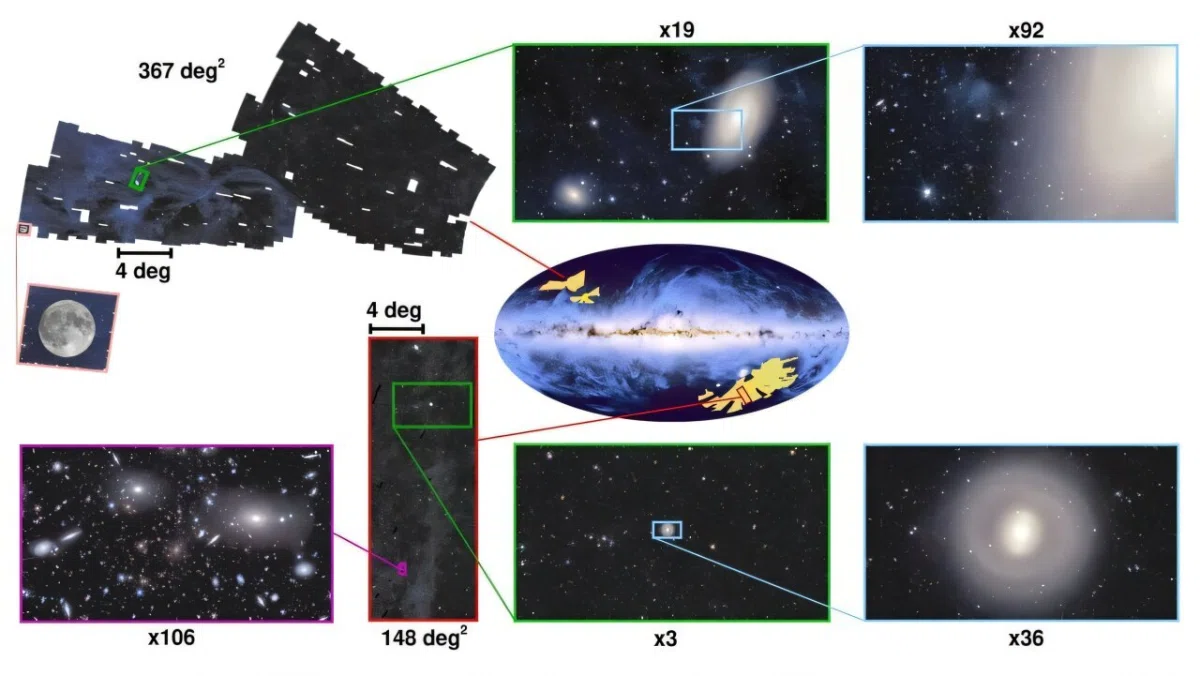
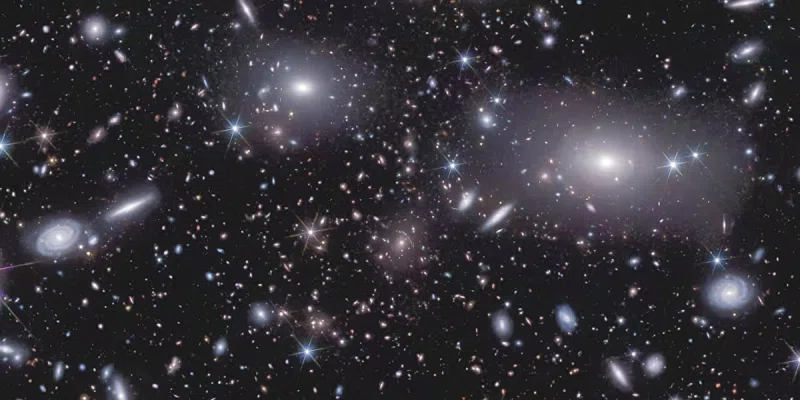
The European Space Agency's Euclid mission has released DR1-Foundation, a data set containing more than one year of observations. This release covers a sky area as large as about 9,500 full moons and captures light from more than 1 billion objects. It took approximately 13 months to gather the data.
The data comes from Euclid's Wide and Deep Surveys, which will form the backbone of a 3D map of the universe. The Wide Survey is the primary campaign and will cover almost half of the galactic sky using visible and near-infrared light. The Deep Survey will look more closely to find fainter objects like dwarf galaxies, low-mass galaxies, tidal tails, high-redshift galaxies, and quasars.
The current data covers 1,900 square degrees, representing about 14% of the sky the telescope will cover during its six-year mission. Euclid has also captured images of the ring galaxy NGC 1291 and the galaxy cluster Abell 3128.
Prof Andy Taylor of the University of Edinburgh said that while there are bigger surveys, none have the detail and information content of Euclid. He noted that Euclid can maintain high resolution while mapping huge volumes of the sky. Taylor said the data contains about 15,000 probable cases of strong gravitational lensing, with 170,000 expected by the end of the mission.
Scientists aim to use the data to understand dark energy and dark matter, which are thought to make up about 70% and 25% of the universe respectively. By studying galaxy superclusters, filaments, and voids, Euclid will provide insights into these substances. Strong gravitational lensing can help scientists find how dark matter is clumping, which is diagnostic of the type of matter it is.
Key facts
- The DR1-Foundation data release covers an area equivalent to 9,500 full moons.
- Euclid's data captures light from more than 1 billion objects.
- The mission aims to map one third of the sky and more than 10bn years of cosmic history.
- The current data release includes approximately 15,000 probable cases of strong gravitational lensing.
Perspectives
Neutral
The ESA's Euclid mission has released its DR1-Foundation data, covering 1,900 square degrees of the sky and more than 1 billion objects.
Positive
The mission provides high-resolution images of huge volumes of the universe to help scientists study dark energy and dark matter.
Your week in news, every Wednesday
The biggest stories of the week for your edition, in your inbox every Wednesday morning, your time. Free, and you can unsubscribe at any time.