Euclid mission data reveals thousands of gravitational lensing cases
New data from the European Space Agency's Euclid mission has identified about 15,000 probable cases of strong gravitational lensing.
 Space Desk 2 min read
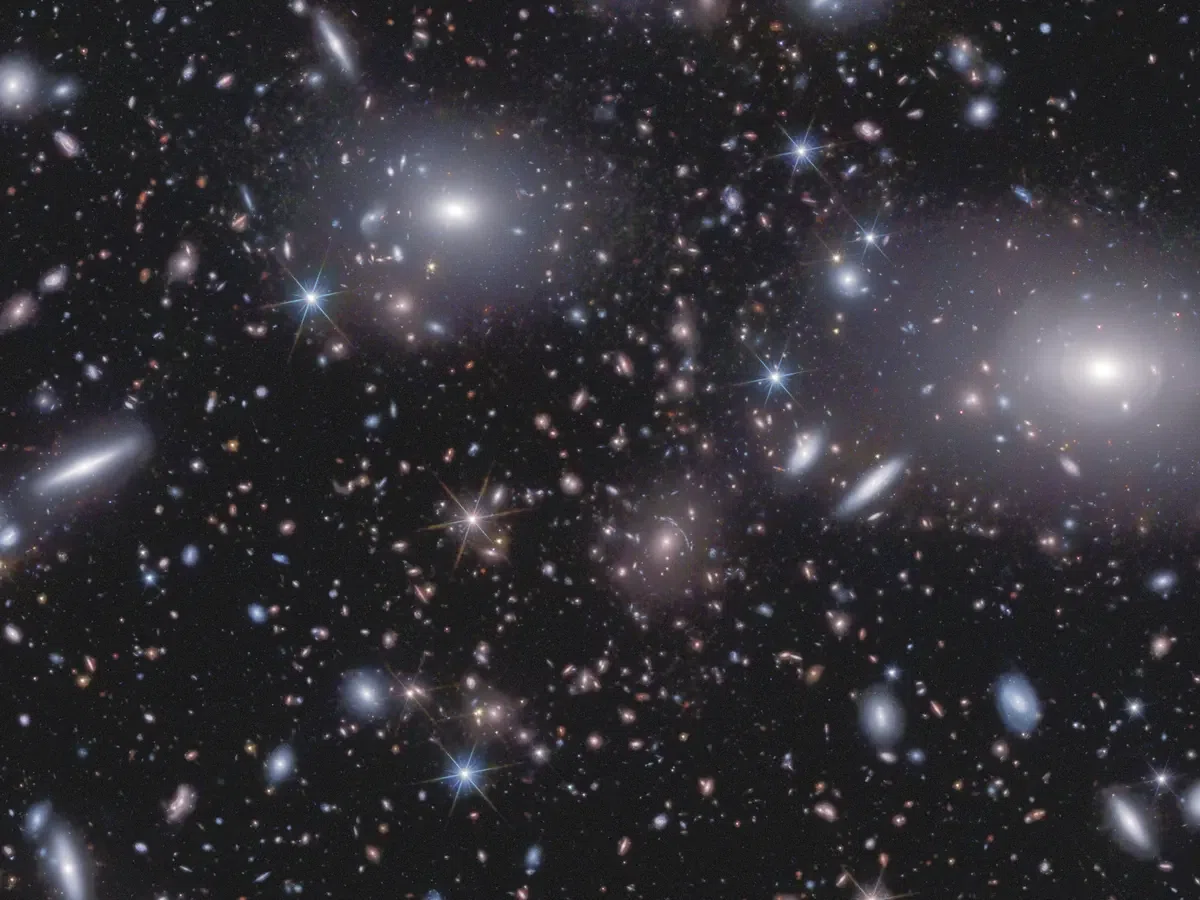
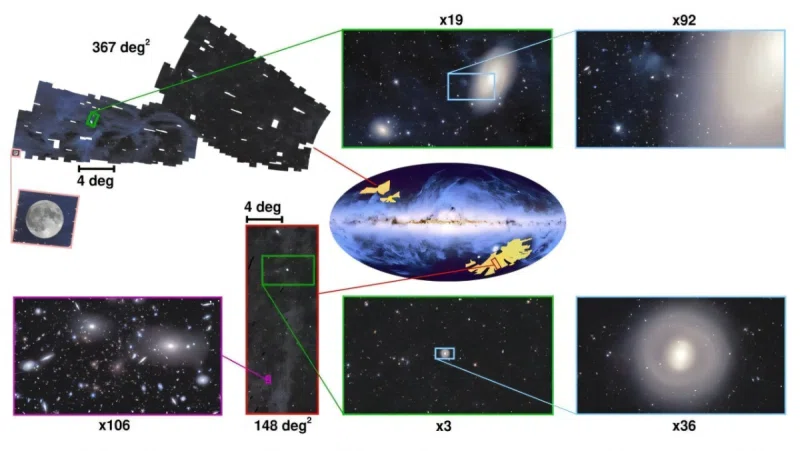
The European Space Agency’s Euclid mission has provided an unprecedented view of the cosmos, revealing many more cases of gravitational lensing. Newly released data captures over 900m galaxies and more than 60m potential quasars, which are blazing objects at the centre of distant galaxies powered by supermassive black holes.
While experts previously knew of about 1,000 cases of strong gravitational lensing, the Euclid data contains about 15,000 probable cases. Scientists expect to discover 170,000 cases by the end of the mission.
Gravitational lensing is a magnification effect that occurs when one galaxy sits in front of another distant galaxy. Einstein predicted the gravitational influence of the foreground galaxy would distort space-time, bending light from the background galaxy to create bright arcs or rings. This effect is significantly boosted by dark matter, which increases the mass and gravitational influence of a galaxy.
Prof Andy Taylor of the University of Edinburgh, who leads the UK science ground segment for the mission, said the data allows scientists to use patterns of distortions to make a map of where all the dark matter is in the universe. By studying strong gravitational lensing, scientists may be able to rule out different theories on the nature of dark matter because the lensing is influenced by how the substance is distributed.
Stephen Serjeant, a professor of astronomy at the Open University, said finding how dark matter is clumping is diagnostic of the type of matter it is. He said there is a good chance a breakthrough in the properties of dark matter might come from strong gravitational lensing.
Launched in July 2023, Euclid aims to create the largest 3D map of the universe, covering a third of the sky and more than 10bn years of cosmic history. The mission's goal is to investigate the nature of dark energy and dark matter, which are thought to make up about 70% and 25% of the universe respectively.
Key facts
- Euclid data contains about 15,000 probable cases of strong gravitational lensing.
- The mission expects to discover 170,000 cases by its end.
- Dark energy and dark matter are thought to make up about 70% and 25% of the universe.
Three perspectives
Neutral
The Euclid mission is providing high-resolution data to map huge volumes of the sky and study dark matter and dark energy.
Positive
The mission's data provides a chance for a breakthrough in understanding the properties of dark matter through strong gravitational lensing.
Negative
The Euclid data is now too big for any human eyeball to look at.
Your week in news, every Wednesday
The biggest stories of the week for your edition, in your inbox every Wednesday morning, your time. Free, and you can unsubscribe at any time.