Canada
Space
Amateur astronomers join NASA's Kilonova Catcher network to track cosmic flashes
The volunteer network helps follow fading light from gravitational-wave alerts and is preparing for alerts from the Nancy Grace Roman Space Telescope.
 Space
The volunteer network helps follow fading light from gravitational-wave alerts and is preparing for alerts from the Nancy Grace Roman Space Telescope.
The quasar J1504+6252, nicknamed Dún Aonghasa, was seen 630 million years after the Big Bang.
 China
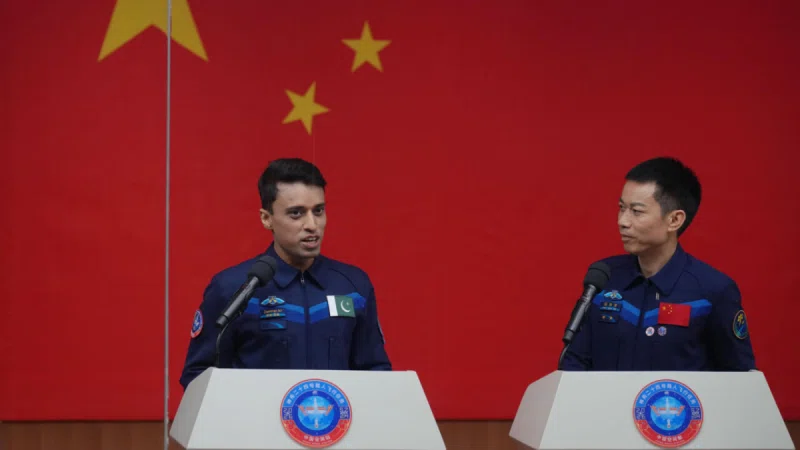
Muhammad Zeeshan Ali will join the Shenzhou-24 mission launching Wednesday from the Gobi Desert.
The spacecraft overcame a last-minute glitch to become only the second craft to orbit the planet closest to the sun.
Dust in the supernova remnant suggests the star's interior changed, possibly just hours before it died.
The Hera mission will conduct a close-up investigation of the Dimorphos asteroid to study the effects of the 2022 DART collision.
The European Space Agency confirmed the spacecraft is safe and in a stable orbit despite a thruster malfunction that interrupted a planned maneuver.
The November full Moon marks the beginning of a sequence of four consecutive supermoons ending in February 2027.
New research shows how a spherical black hole and a surrounding ring-shaped black hole can rotate independently in two planes.
 Iceland
The American astronaut, who travelled around the Moon in April on Artemis II, received the main award at the 12th Explorers Festival.
The smallest planet in the solar system is well placed for observation following its greatest western elongation.
 Norway
The new system at the Ny-Ålesund Geodetic Observatory provides faster and more precise tracking of satellites and Earth's surface changes.
Researchers say a hypothetical world they call Planet X2 could explain odd orbits of distant icy bodies such as Sedna, but it has not been detected.
Researchers at Oregon State University found potatoes matched Earth-soil yields when lunar simulant was mixed with 30% vermicompost.
The 1977 robotic probe has traveled approximately 16 billion kilometres into interstellar space, according to NASA computations.
The two planets appeared close together early Monday morning.
The spacecraft returned to the Starbase facility on Saturday after a 22-hour mission, marking a major milestone for the fully reusable rocket system.
The discovery of a long-period radio transient involving a sun-like star provides new insights into stellar evolution and the potential for undiscovered binary systems.
The object is approximately 11 metres wide and is moving near Earth.
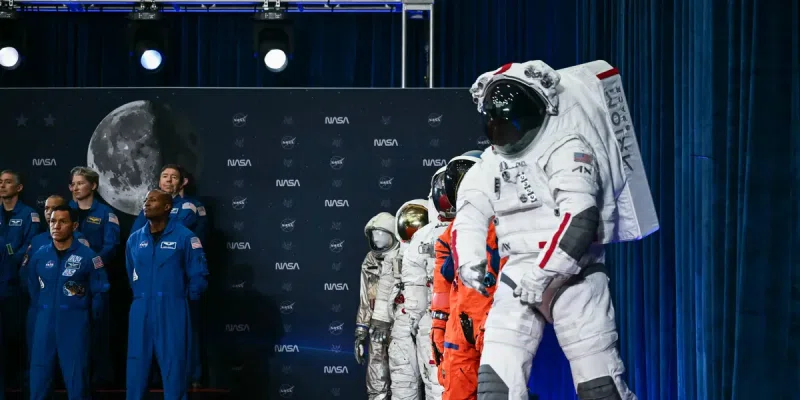
The space-bound humans could go to the moon, build a lunar base, or even head to Mars.
Astronomers detected a brief gamma-ray burst, followed by a 10-minute X-ray signal, possibly from a neutron star merger. The event was observed in a distant galaxy.
The Draconid meteor shower will peak on October 8. The Taurids will also be visible in October.
The Sentinel-3C satellite has passed its first test, returning striking new images of Earth. The images include Italy's stunning landscape.
Moderate storms likely on October 11, 2026, with possible Northern Lights displays in 28 states.
Four astronauts have returned to Earth after nearly eight months in space, completing the Crew-12 mission to the International Space Station. The crew splashed down off the coast of Los Angeles, California, at 11:34 a.m. EDT.
NASA has made nearly 1 TB of data from the Artemis II mission available to the public, including photographs, audio, and handwritten notes from the astronauts. The data will be used to study the moon and prepare for future human missions.
The European Space Agency has awarded contracts to two consortia to study the feasibility of a European-led orbital outpost in low Earth orbit. The move is part of the agency's preparations for the end of the International Space Station's utilisation.